Metal in a building rarely appears as a heroic single object. It appears as hundreds of identical small things: the bracket that carries a rainscreen panel, the clip that holds a ceiling grid, the perforated screen shading a west elevation, the anchor plate welded to a steel frame, the trim that closes a parapet. Each of those is a candidate for stamping, and each is usually specified — or quietly value-engineered — without a clear view of what the process can and cannot hold.
The gap matters because stamping is the cheapest way to make a metal component in volume and one of the most expensive ways to make it in small numbers. Architects and specifiers who understand where that line falls can keep a façade detail intact through a cost review. Those who do not tend to lose the detail to a laser-cut substitute, or worse, approve a die that never pays back.
The Components That Are Actually Stamped
Four families dominate architectural metalwork.
Connection and support hardware — brackets, angle cleats, base plates, hangers, rail carriers, panel clips. These are flat, small, and needed by the thousand on a single project. They are also the parts where a 0.3 mm deviation in a fold becomes a visible misalignment 20 metres up a façade.
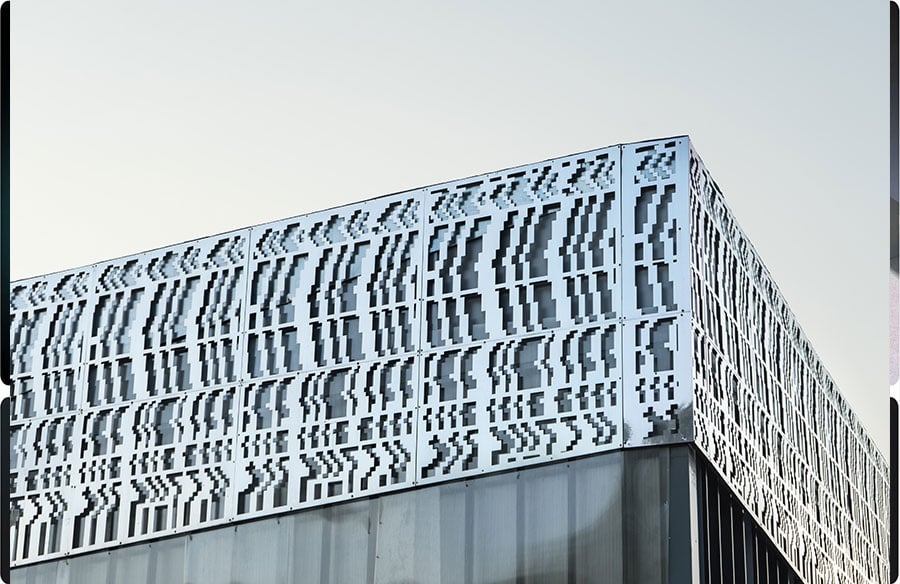
Perforated and patterned screens — sunshades, balustrade infill, acoustic panels, ventilation grilles. Stamping produces the perforation pattern and the edge stiffening in one tool, which is why perforated sheet is so much cheaper per square metre than an equivalent machined panel.
Trim and closure profiles — coping, flashings, edge trims, reveals. Often roll-formed rather than stamped, but the end caps, corner pieces and fixings that finish them are stamped.
Small architectural hardware — handle plates, hinge components, lock cases, signage carriers.
What these share is a flat starting blank, features in the plane, and a need for repeatability. What they do not share is volume, and volume is the whole argument.
The Tooling Arithmetic Nobody Puts In The Specification
A single-hit tool for a simple bracket might cost a few thousand dollars. A progressive die that punches, forms, and trims a perforated panel in one pass can run well past twenty thousand, and a multi-station die with tight form control can be an order of magnitude above that. That money is spent before the first usable part exists.
Set that against laser cutting, which has no tooling cost at all and a per-part price that barely changes from one unit to a thousand. The crossover point is arithmetic, not opinion. If a laser-cut bracket costs $4.20 and a stamped one costs $1.10 plus a $9,000 die, the die pays back at around 2,900 pieces. Below that, laser cutting plus bending wins — and it also lets you revise the design at no tooling penalty, which on a project still in coordination is worth more than the unit price.
The rule of thumb that survives contact with real projects: stamping becomes the right answer somewhere between 2,000 and 5,000 identical pieces for simple parts, and much higher for complex progressive work. On a façade with 600 panels, each carried by four brackets, you are at 2,400 pieces — right on the line. That is why bracket design so often gets standardised across a project: consolidating three bracket types into one is what pushes the volume over the threshold. It is also why spares, replacements and the next phase of a phased development should be counted in the quantity — a die that is retired after 2,400 pieces because nobody counted the 2029 refit was never a good investment.
Why Stamping And Punching Get Confused
The two terms are used interchangeably on drawings, which causes real quoting errors. Punching is a single shear operation that removes or separates material; stamping is a forming sequence that may include punching, bending, drawing, coining and trimming, in one tool or across several stations. A “punched” component is flat. A stamped one has form.
For architects the practical consequence is tolerance. Flat punched parts hold position well and thickness-related features are predictable. Formed parts accumulate error: every bend carries an angular tolerance, and those tolerances stack across a sequence. A four-bend channel with ±1° per bend can end up out of square by enough to matter over a 1.5-metre length. The differences between metal punching and stamping are worth understanding before you sign off a detail that depends on a folded edge landing flush against another component.
Six Design Rules That Decide Whether The Tool Pays
Keep gauge constant. A part that steps from 1.5 mm to 2.5 mm to solve a local stiffness problem needs a blank of 2.5 mm, or a welded assembly, or a different process. Constant thickness with formed stiffeners is almost always cheaper.
Respect the bend radius. An inside radius below roughly one material thickness cracks on the outside of the bend in most structural grades, and work-hardens austenitic stainless into stress-corrosion territory. Radius equals thickness is the safe default.
Keep holes away from bends. A hole closer than about 1.5 times thickness to a bend line distorts into an ellipse. If the fixing position is fixed by something else — a mullion bracket, a rail pitch — move the bend, not the hole.
Avoid undercuts and side actions. Anything the part cannot release from the die in the press direction adds a cam, a slider, and cost that is disproportionate to the feature’s value.
Design the perforation pattern for the tool. Open area, hole pitch and land width determine strip strength. A pattern that looks elegant in a render can leave a web too narrow to survive the strip feeder, and the fix is a heavier gauge, which changes the whole assembly.
Choose material and finish together. Galvanised steel cut and formed at a stamping die exposes bare edges that rust first; stainless costs more per kilogram but removes the finishing step; aluminium anodises well but scratches easily in handling. Post-stamping powder coating hides tool marks and adds a thickness that changes fit. Specify the finish before the tolerance.
The Coordination Problems That Only Appear On Site
Stamped components behave differently from machined ones in three ways that show up late.
Tolerance stack-up across an assembly. Each bracket is within tolerance, each rail is within tolerance, and the panel still does not sit flat, because the errors are correlated rather than random — every part from one die leans the same way. Building in a slotted or oversize hole at the interface costs nothing at design stage and absorbs the accumulation on site.
Galvanic contact. Stainless clips on aluminium rails, or galvanised brackets on stainless fixings, create a corrosion cell that accelerates in wet, chloride-bearing or humid coastal air. Isolation washers and compatible material pairing belong in the specification, not in a site instruction.
Edge condition. Sheared edges are not coated, and on a perforated screen they are also the most visible surface. Deburring and edge finishing are separate line items; if they are not priced, they are not happening.
A Specification Checklist
For any component you are considering as stamped, confirm the following before the die is ordered:
- Total quantity across all phases of the project, including future refits and spares.
- Whether the same part appears in more than one system and can be standardised.
- Gauge uniformity, and whether stiffness comes from form rather than thickness.
- Bend radii, hole-to-bend distances and release direction, checked against the strip layout.
- The tolerance that actually matters — position, flatness, or angle — and what accumulates from it.
- Material and finish pairing, including what happens at cut edges and at dissimilar-metal interfaces.
- First-article inspection: who measures, against which drawing, before the run continues.
- Whether a precision metal stamping supplier can quote the part as designed, or only as redesigned for their tool.
Where The Decision Really Lands
Stamping is not a premium process and it is not a cheap one. It is a volume process, and its economics reward repetition, standardisation and design discipline. The projects that use it well are the ones where a detail is repeated enough times to justify a tool — and where the architect has already resolved the bend radii, the perforation web and the fixing tolerance before the contractor asks for a price.
The projects that use it badly are the ones where a bespoke detail is stamped because someone assumed volume manufacturing is always cheaper. On a 40-panel project, a laser-cut bracket bent on a press brake is not a compromise. It is the correct answer, and knowing that is what lets you spend the tooling budget where repetition genuinely exists.