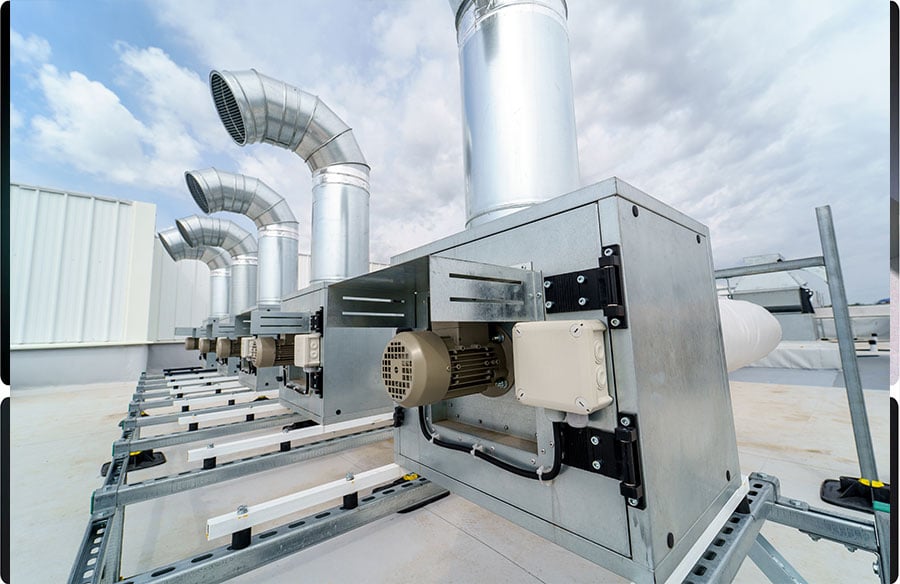
Let’s talk about something that does a brilliant job and gets almost no thanks, the humble MEV (Mechanical Extract Ventilation) unit. It sits quietly in your loft or cupboard, humming away like a very polite housemate, whisking out stale air while you get on with your life. If your home has ever felt a bit stuffy, or your bathroom mirror has stayed steamed up longer than it takes you to get dressed, then this guide is for you…
What Exactly Is an MEV Unit?
MEV stands for Mechanical Extract Ventilation. In plain English, it is a single fan unit that pulls moist, stale air out of the wettest rooms in your home, usually the kitchen, bathrooms, utility room and any en suites. It does this through a network of ducts connected to vents in each of those rooms. As air is drawn out, fresh air finds its way back in naturally through small trickle vents in your windows or through gaps in the building fabric. Think of it as the house taking a long, slow, healthy breath out, while the fresh stuff sneaks in through the back door.
Why We Need Them
Our lovely island has a climate best described as “optimistically damp”. Add to that the fact that modern homes are built to be wonderfully airtight (great for heating bills, less great for airflow), and you have a recipe for condensation. Cooking, showering, drying laundry on radiators and even breathing all add moisture to the air. Without somewhere to go, that moisture lands on cold surfaces and starts to cause trouble. An MEV unit tackles this head on. It runs continuously, so moisture is dealt with before it has the chance to settle in and invite its friend, black mould, to move in permanently.
How Does It Work?
Here is the clever bit. A standard MEV unit runs all day and all night at a low background speed. It is very quiet and uses a tiny amount of electricity, often less than a light bulb. When you need a bit more oomph, such as when you jump in the shower or fry some bacon, the unit steps up to a higher speed. This boost can be triggered in a few ways:
– A light switch linked to the room
– A humidity sensor that notices steam
– A manual pull cord or switch
– A timer that keeps it boosting for a set period after you leave
Once the moment passes, it drops back down to its gentle cruise setting.
MEV vs the Humble Extractor Fan
You might be wondering how this differs from the little fans you find in many bathrooms. Fair question! Individual extractor fans work room by room, they tend to be noisy, and they only run when someone remembers to switch them on (or when someone remembers to switch them off, as the case may be). An MEV unit is a whole house solution. One central fan serves every wet room, runs constantly and manages itself. It is the difference between having several people each bailing out a leaky boat with a teacup, and having one properly competent bilge pump.
MEV vs MVHR
Now for the cousin you may have heard about. MVHR stands for Mechanical Ventilation with Heat Recovery. It does a similar job but also captures warmth from the outgoing air and uses it to warm the incoming air. It is fantastic, but it costs more to buy, takes more space and needs more complicated ductwork. MEV is simpler, cheaper and easier to fit, which makes it a popular choice for new builds, renovations and social housing across the country. If your home is reasonably (but not extremely) airtight, MEV is often the sweet spot.
The Benefits, Without the Boring Bits
MEV units come with many benefits, but here are just a few without boring you with the geeky stuff…
– Fewer condensation woes: Dry windows, dry walls, happy homeowner.
– Healthier air: Less damp means fewer allergens, dust mites and mould spores floating about.
– Low running costs: Modern units are efficient, often costing just a few pounds a year to run.
– Quiet operation: You should barely notice it, apart from a gentle hum at boost speed.
– Low maintenance: There is very little to go wrong, which suits those of us who think servicing means doing the washing up.
– Building regulations friendly: Many new homes in the UK need a ventilation strategy, and MEV ticks that box nicely.
Installation: DIY or Call a Pro?
Here is where we gently suggest keeping your toolbox closed. MEV systems rely on properly designed ductwork, correct airflow balancing and sensible vent positioning. Get any of those wrong and the system will underperform, or worse, make a racket. A qualified installer will survey your home, size the system and make sure everything meets Building Regulations. They will also commission the system properly, which means checking that each room is extracting the right amount of air. It is money well spent.
Maintenance
Maintenance really is minimal, but a few good habits won’t go amiss…
– Wipe down extract vents every few months, as dust loves to collect there.
– Never block or cover a vent, however tempting it seems when the draught gets chilly.
– Keep those window trickle vents open so fresh air can flow in.
– Have the system checked now and then by a professional, especially if it starts sounding different.
– Check any filters if your model has them, and replace them as recommended.
And finally, an MEV unit may not be glamorous, and it will never be the star of a dinner party conversation (unless you invite the right sort of guests). But as a way to keep your home fresh, dry and healthy, it is hard to beat. It works quietly, costs little and protects your property from the damp and mould that so many British homes battle. So if you are building, renovating or simply tired of wiping the bathroom ceiling, have a chat with a qualified installer about MEV. Your walls, your lungs and your bathroom mirror will all thank you.