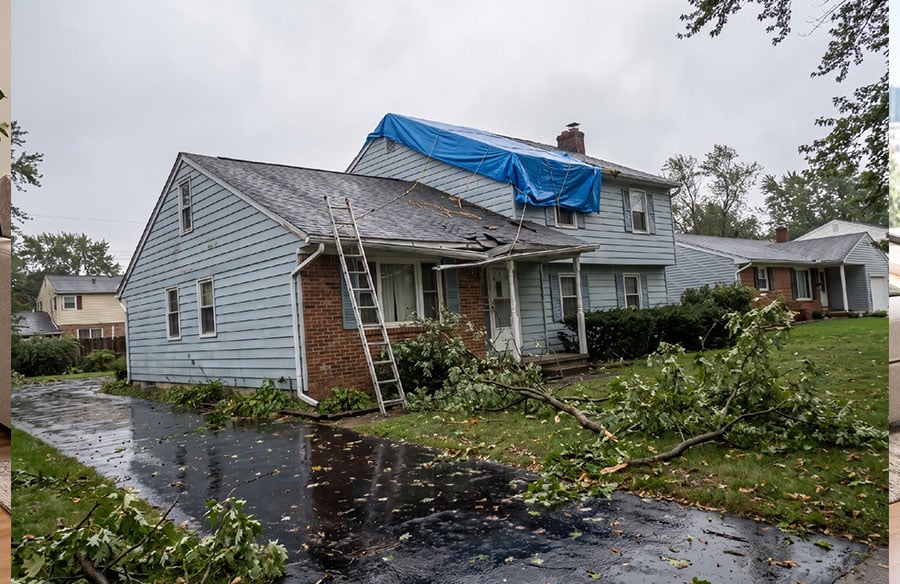
A tarped roof section like this is often the first sign of a homeowner racing to protect their property before the full extent of the damage has been documented.
Ohio’s weather has gotten meaner, and homeowners are paying for it twice – once in premiums, and again when a claim doesn’t cover what it should. Severe storms roll through the state more often now, and insurers have taken notice. Rates have climbed, scrutiny has tightened, and the gap between what a homeowner expects from a claim and what they actually receive keeps growing. When damage strikes, the instinct is to fix it fast. That instinct, more often than not, is exactly what costs people money. This piece walks through why claims fail, how renovation work adds another layer of risk, and what homeowners can do before repairs ever begin.
Ohio’s Storm Season Is Getting Costlier for Homeowners
Wind and hail account for 40.7% of all U.S. homeowners insurance claims, according to 2022 data from the Insurance Information Institute (Triple-I) – the single largest category of loss nationwide. Ohio has felt that trend acutely. A January 2025 analysis reported by the Dayton Daily News found that Ohio homeowners insurance rates rose 36.4% between 2019 and 2024, driven in large part by an uptick in tornado activity and storm-related losses across the state. The May 2025 Midwest tornado outbreak alone produced more than 60 tornadoes across the region in a single 48-hour stretch, and a December 2025 winter storm added another round of wind and ice damage to the tally.
As claims become more frequent, insurers dig in harder on documentation. Adjusters working for the insurance company are, by design, working to limit what the company pays out. That’s not a conspiracy, it’s the job. It’s also why more homeowners are turning to an independent Ohio public adjuster to represent their side of the claim, someone licensed under Ohio Revised Code Chapter 3951 whose only job is to advocate for the policyholder, not the insurer.
Why Rushing Repairs Can Undermine Your Claim
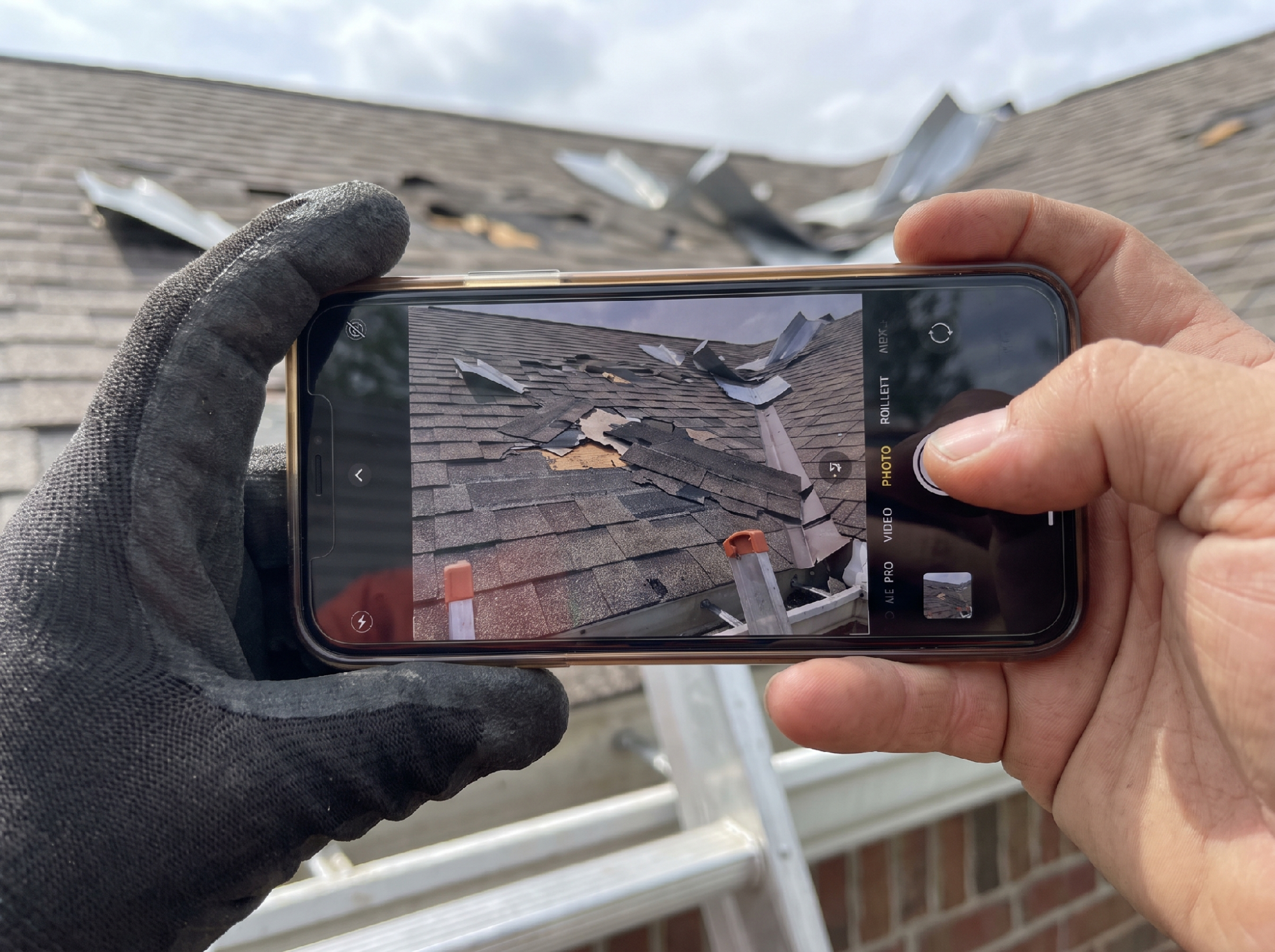 Photographing every angle of the damage before repairs start gives an insurer nothing to dispute later.
The most common mistake homeowners make after a storm is calling a contractor before calling their insurer. Once shingles are torn off and new ones nailed down, the original damage is gone, and so is the evidence. Temporary mitigation, tarping a roof or boarding a broken window, is expected and even required under most policies to prevent further loss. Permanent repairs are a different story entirely.
Insurers need to see the damage as it happened, not a description of it after the fact. That means photos and video from multiple angles, dated and time-stamped, ideally taken the same day the damage occurred or as soon as it’s safe to do so. This matters even more when the most common causes of roof damage homeowners face overlap with normal wear, since an insurer looking for a reason to deny a claim will seize on any ambiguity. Wait for a proper assessment. It’s a few extra days that can be the difference between a fully paid claim and a partial one.
When Renovation Work Complicates a Claim
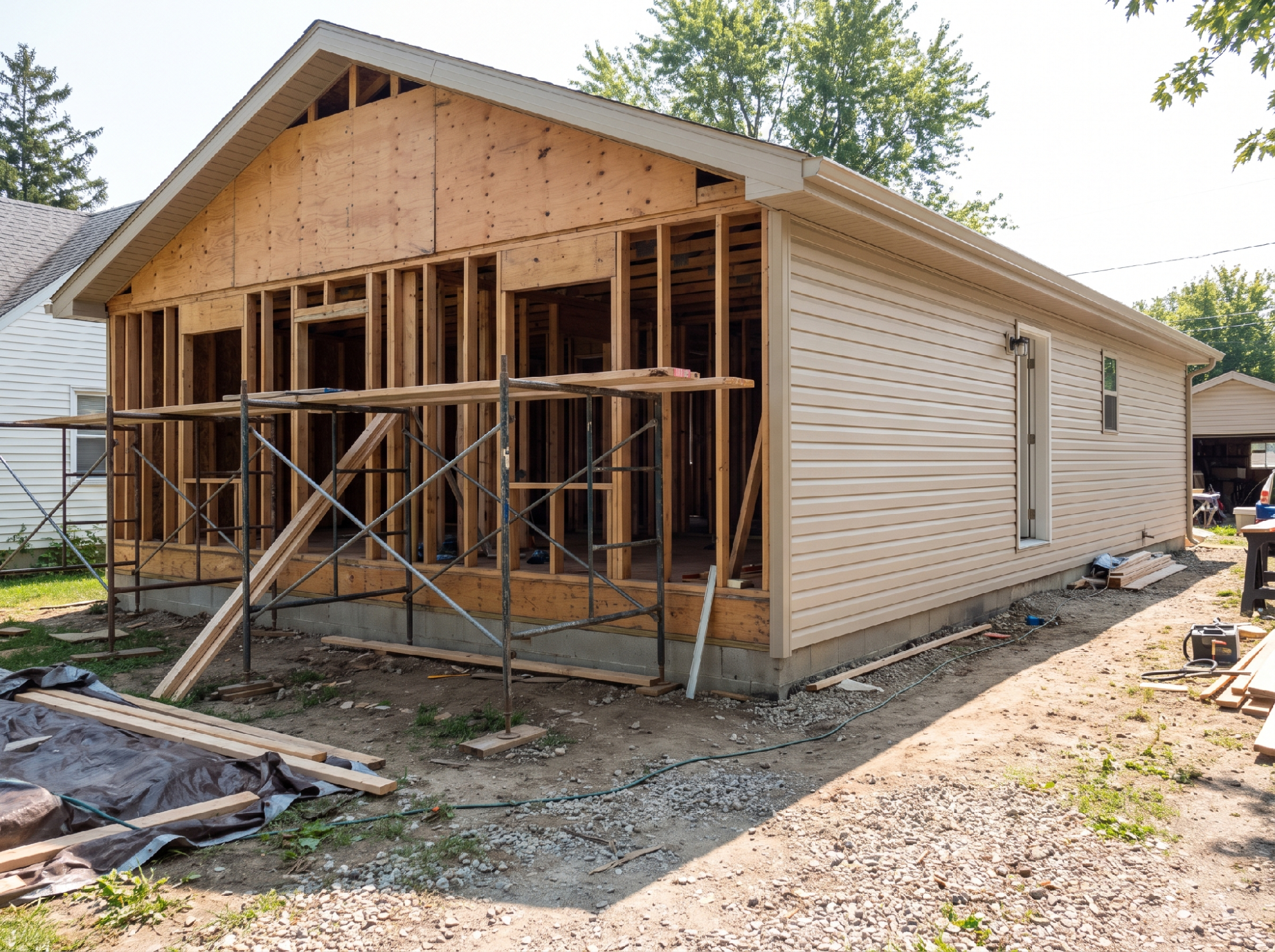 Ongoing renovation work can blur the line between pre-existing conditions and new storm damage, a frequent point of dispute with insurers.
Homeowners in the middle of a renovation face a harder road when storm damage hits. Insurance policies almost universally exclude damage caused by faulty workmanship, so if a claim adjuster spots exposed framing, incomplete flashing, or recent construction near the damaged area, the default assumption often shifts toward “pre-existing condition” or “contractor error” rather than storm causation.
That doesn’t mean the claim is doomed, but it does mean the burden of proof lands squarely on the homeowner. Keeping renovation permits, contractor certificates of insurance, and dated before-and-after photos on hand isn’t paperwork for paperwork’s sake, it’s what separates a paid claim from a denied one. Homeowners planning upgrades should think carefully about exterior features worth protecting when storm damage strikes, since the areas most likely to increase a home’s value are often the same ones insurers scrutinize hardest after a loss.
What Ohio’s Licensing Rules Mean for Homeowners
Not everyone offering to “help” with a claim is qualified to do it. Ohio regulates public adjusters under Chapter 3951 of the Ohio Revised Code, and the requirements aren’t minor. Adjusters must pass a state exam with a minimum score of 70%, carry a surety bond, and stay licensed through the Ohio Department of Insurance, according to licensing guidance compiled by StateRequirement. That licensing structure exists for a reason: it filters out unqualified operators and gives homeowners a legal, accountable advocate rather than a handshake promise.
Contractors sometimes offer to handle the insurance side of a storm repair themselves. That arrangement can work fine for straightforward claims, but it also creates an obvious conflict of interest when the same party estimating the damage stands to profit from the repair contract. A licensed adjuster has no stake in which contractor gets hired.
How Long Ohio Roofs Really Last – and Why That Matters for Claims
One of the most common reasons insurers deny or reduce a storm claim is the “wear and tear” argument, the idea that a roof was already near the end of its life before the storm hit. Understanding how long roofs typically last before storm damage becomes a bigger risk helps homeowners push back on that argument with facts instead of frustration. A well-maintained asphalt roof with documented inspection history is a much harder target for a wear-and-tear denial than one with no paper trail at all.
That paper trail matters more every year. The Insurance Research Council’s 2025 Homeowners Insurance Affordability Research Brief found that claim costs have been rising faster than general inflation, which gives insurers added financial incentive to challenge borderline claims rather than pay them outright. A dated inspection report or maintenance log won’t guarantee a payout, but it removes one of the easiest arguments an insurer has for cutting a check short.
The Real Price of Storm Damage Keeps Rising
Property damage, including wind, hail, and storm losses, made up roughly 97-98% of all U.S. homeowners insurance claims between 2018 and 2022, with an average payout of $15,749, according to Triple-I data drawn from ISO. Ohio’s own numbers tell a similar story at the local level. The Ohio Insurance Agents Association’s 2026 Ohio Storm Events Summary, built on data from NOAA’s National Centers for Environmental Information, maps county-by-county storm losses across the state and shows just how widespread last year’s damage really was.
None of that data changes what happens at a homeowner’s kitchen table, though. What changes the outcome is preparation: knowing what to photograph, when to wait, and who’s actually on your side of the negotiation.
Protecting Your Claim Before the Repairs Start
Ohio’s storms aren’t slowing down, and neither are insurance premiums. Homeowners who come out ahead after a loss aren’t the ones who move fastest, they’re the ones who document everything before a single nail goes back in. That means photos before mitigation, a clear paper trail on any ongoing renovation work, and a willingness to slow down long enough for a proper assessment. Storm damage is stressful enough without a denied claim on top of it. A little patience at the start of the process tends to pay for itself many times over by the end.