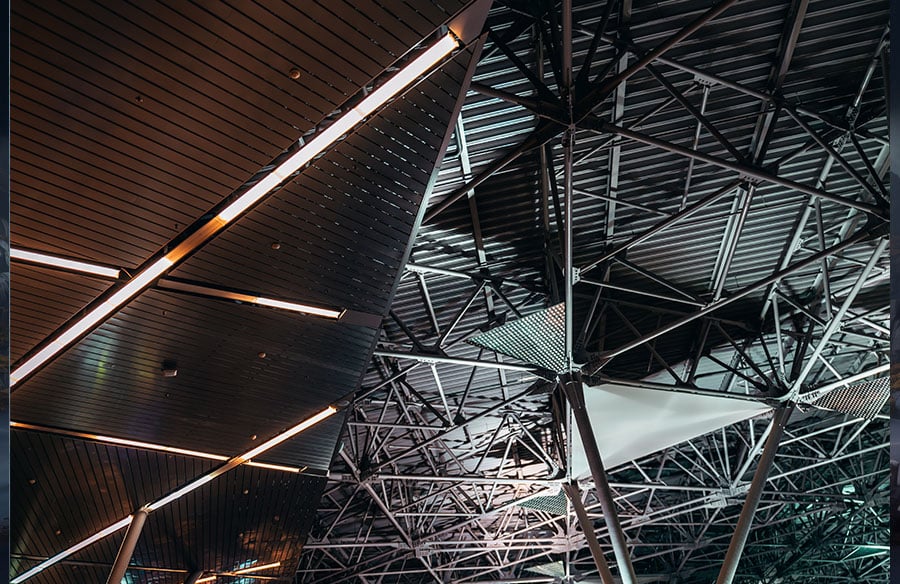
Concrete ceilings are boring. You know it, and so does every client who walks into a loft-style office and immediately asks, “Can we keep the steel exposed?” The honest answer is yes, you can, and it does not have to be a life-safety nightmare. The risk is real, but it is also manageable, and the tools to manage it have gotten dramatically better in the last twenty years. This article walks through what actually happens to steel in a fire, how the code treats exposed structure, and the coating systems that let you keep the raw look without crossing the line into a hazard.
What Really Happens to Steel When It Gets Hot
Here is the part that surprises most people: steel does not catch fire. It melts at around 2,700 degrees Fahrenheit, and a typical building fire rarely gets that hot. But steel’s problem is not melting, it is losing its strength much earlier. At roughly 1,000 degrees Fahrenheit, structural steel retains only about half of its room-temperature load capacity. In a fully developed fire, a bare steel beam can reach that temperature in ten to fifteen minutes, long before occupants have evacuated and long before firefighters can mount an interior attack.
The mechanics matter to your design. When steel heats up, it expands, and when it expands unevenly, it warps. A beam that was perfectly straight at noon can be sagging by 12:05. The National Institute of Standards and Technology (NIST) has studied this phenomenon extensively following major structural fires, and their reports consistently show that unprotected steel loses its integrity well before the fire is controlled. If you want to keep steel visible, you cannot ignore the thermal reality of the material.
What the Code Demands From Structure
Building codes are not trying to ruin your aesthetic. They are trying to keep a structure standing long enough for everyone to get out and for firefighters to do their job. The International Building Code sets fire-resistance ratings for structural members based on the building’s occupancy and height. A low-rise warehouse might only need a one-hour rating on its columns. A high-rise office could require three hours on its core structure.
The key phrase in the code is “fire-resistance rating.” That rating is not about how hot the fire gets. It is about how long an assembly can contain a fire and maintain its structural capacity during a standardized test. When you see “two-hour rated beam” in a spec, that means the assembly, including whatever protection is applied to the steel, passed a specific ASTM E119 test. The steel does not have to do it alone, and in most cases, it should not.
Your Three Options for Protecting Exposed Steel
You have got three main paths when you want to keep steel visible but code-compliant, and each carries different tradeoffs.
Option one: spray-applied fire-resistive materials. This is the old standby. Cementitious or gypsum-based sprays go on thick, often an inch or more, and they are cheap. But they look like stucco on a ceiling, which defeats the entire purpose of exposed steel. You can cover them with paint, but you lose the crisp steel profile that clients want.
Option two: intumescent coatings. This is where the design freedom lives. Intumescent fireproofing is a thin-film paint that looks like ordinary architectural coating when applied. In a fire, it undergoes a chemical reaction where it expands to many times its original thickness, forming a char layer that insulates the steel and slows the temperature rise. The International Association for Fire Safety Science (IAFSS), which publishes peer reviewed fire science research annually, has documented the performance of char-forming coatings across multiple fire scenarios. The paint is on the wall at one-sixtieth of an inch, and in a fire, it swells into a protective blanket.
Option three: board or blanket systems. These are prefabricated panels or mineral wool wraps that get installed around the steel. They protect well, but they box in the beam, and they add assembly time. They make sense in shafts or concealed spaces, rarely in a statement ceiling.
For exposed ceilings, intumescent coating is usually the pick. It gives you true thin-film aesthetics with real fire ratings.
What Specifiers Get Wrong About Intumescent Systems
The biggest mistake I see on drawings is treating intumescent paint like any other architectural coating. It is not. It is a performance system that depends on the substrate, the environment, and the applicator. Here is what actually goes wrong on site.
First, the substrate prep. Intumescent coatings only work when they bond to clean, blast-cleaned steel. If the steel arrives with mill scale or rust, the coating will delaminate in a fire exactly when you need it most. The specification must require abrasive blasting to a defined standard, not just a shop towel and a prayer.
Second, the DFT, or dry film thickness. The fire rating hinges on applying enough coating. An intumescent product that provides a one-hour rating at 20 mils dry might provide two hours at 35 mils. Contractors who rush the job and apply a thin coat for cosmetics end up with zero fire protection. You need to call for wet film thickness checks during application and verify dry film thickness afterward.
Third, and this one surprises a lot of architects, the environment. Most intumescent products are hygroscopic, meaning they absorb moisture. They are designed for interior, climate-controlled spaces. If you spec an interior-grade system in a parking garage or an exterior canopy, the coating will degrade. Read the product’s environmental limits and write them into the spec. The National Institute of Standards and Technology publishes guidance on coating durability and environmental stress testing, and their data shows that moisture cycling is the main driver of premature coating failure.
And fourth, the topcoat. Intumescent coatings are often sensitive to UV light and typically need a decorative topcoat to protect them. That topcoat needs to be compatible with the intumescent system. Not every architectural paint plays nice with the char-forming chemistry underneath.
If you are weighing the options for a specific project, talking to a manufacturer about the performance data upfront is worth an afternoon. A reputable coatings company will supply test documentation, listing the exact assembly that achieved the rating. When you look at a system like intumescent fireproofing, the manufacturer should hand you the third party test reports without hesitation. If they cannot, walk away.
A Field Scenario You Have to Plan For
Let me give you a concrete situation. You are on a renovation of a 1970s office building, and the client wants the existing steel beams exposed in the new open-plan layout. The steel is sound, but it was originally fireproofed with a cementitious spray that has been covered by three layers of acoustic tile over the decades. So, what do you do?
Step one is the assessment. Have the existing steel and the remaining fireproofing inspected. In many older buildings, the original spray has spalled off in chunks or has been scraped away during previous mechanical upgrades. You cannot assume any of it is viable.
Step two is the cost conversation. You will likely need to remove the remaining old fireproofing, blast-clean the steel, and apply a new intumescent system. That is a real line item, often two to three times the cost of an architectural paint job on the same surface.
Step three is the schedule. Intumescent application is a multi-coat process with curing times between coats. In a renovation, that means sequencing the coating work around other trades.
The Cost Reality Nobody Talks About
Intumescent coatings are more expensive per square foot than traditional spray-applied fireproofing. The material cost alone can be double, and the surface prep adds even more. On big projects, that premium can run into six figures. So why do architects still spec them?
Because the alternative is often worse. If you box in the steel with drywall, you lose the ceiling height and the visual openness that the client paid for. If you use cementitious spray, the space looks like a parking garage. Intumescent coatings are the only system that satisfies the code and the design intent at the same time. The U.S. Fire Administration compiles national fire loss data each year, and their statistics on structural collapses during fires underline the stakes of getting the protection right. You are buying safety, aesthetics, and spatial experience in one product.
So, Should You Keep the Steel Exposed?
Yes, if you are willing to spec the protection correctly. The steel itself is not the hazard, the unprotected steel is. Intumescent systems have proven themselves in standard tests and in real fires, and they give you the thin-film finish that keeps a design honest. But the material only performs when the substrate is clean, the thickness is verified, and the environmental limits are respected.
Before you put that bare beam in your next set of drawings, ask yourself three questions. Have I confirmed the required fire rating for this occupancy? Have I specified the surface preparation? Have I scheduled a thickness verification? If you can answer all three, you are ready to expose that steel and sleep at night.