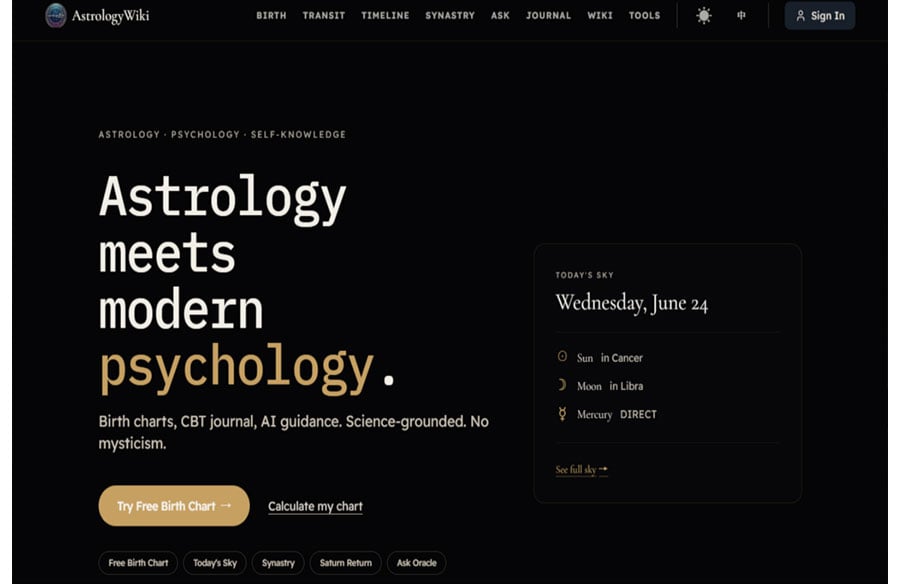
For years, the standard promise of free astrology tools has been the same: enter a birth date, receive a personality summary, and get a vague sense of what the future holds. But a growing number of users are starting to question that framework. Not because they don’t believe in the planetary patterns, but because they find predictive readings either too generic or too anxiety-inducing. What would it look like to approach astrology as a mirror rather than a crystal ball? That question led to a closer look at a platform that explicitly positions itself around “empowerment over fatalism” AstrologyWiki.
A Different Premise: Observing Patterns Instead of Predicting Events
Most astrology sites begin with a simple transaction: birth data in, forecast out. AstrologyWiki starts from a different assumption. Its entire framework is rooted in psychological astrology, drawing on archetypal psychology to interpret celestial positions as reflections of internal dynamics rather than external destinies. This isn’t just a tagline; it permeates every reading. When a sample birth chart was generated, the interpretation did not mention fate or unavoidable outcomes. Instead, it described tendencies, habitual responses, and psychological reflexes—the kind of behaviors that anyone might recognise in their own life with a little reflection.
The platform’s language is intentionally grounded. It describes itself as “science-grounded” and promises “no mysticism”. The calculations rely on the Swiss Ephemeris, the same astronomical database used by professional astronomers, while the interpretations consistently steer toward practical self-awareness. That combination—precision data paired with psychological framing—makes the experience feel credible without sacrificing accessibility.
Three Core Tools, Each Built Around a Single Purpose
Rather than offering a sprawling suite of features, AstrologyWiki keeps its instrument set deliberately small. As the site notes, it provides “a small set of sharp instruments. Not 50 features”. This restraint helps users focus on what actually matters: understanding their own chart, staying aware of the daily sky, and exploring relationship dynamics.
Birth Chart: A Portrait of Tendencies, Not a Label
The birth chart generator produces a full planetary layout in roughly thirty seconds. The visual presentation is straightforward—a clear circular chart with planets, houses, and aspects visibly marked. But the real value lies in the accompanying text, which frames each placement in psychological terms rather than deterministic ones.
For example, a Saturn placement was not described as a “karmic lesson” or an obstacle to overcome. Instead, it was interpreted as an area where pressure tends to accumulate—and an invitation to examine what one genuinely values beneath that weight. That shift in framing makes the information more usable: predictions cannot be changed, but behavioural patterns can be observed and, over time, adjusted.
Today’s Sky: A Daily Lens Without the Overpromise
The Today’s Sky tool tracks current planetary transits, but again, the interpretation stays observational. On a day with a Venus-Neptune trine, the reading noted that the transit softens boundaries and encourages emotional connection, while also gently reminding users to stay grounded to avoid idealising people or situations.
This kind of framing offers a thematic lens for the day without promising specific events. It encourages the user to notice what might emerge in conversations or personal reflections, rather than waiting for external circumstances to align.
Synastry: Relationship Astrology Without the Soulmate Narrative
The synastry tool overlays two birth charts to show where they meet, clash, and recognise each other. The platform explicitly markets this as “relationship astrology without the soulmate gloss”—a refreshing departure from the usual twin‑flame rhetoric.
In practice, the synastry readings concentrate on communication styles, emotional needs, and potential friction points. They avoid stating whether a relationship is “destined” to succeed or fail, instead describing the geometry between the two charts: where flow is natural, where effort may be required, and where mutual understanding might need extra attention
How the Platform Works: A Straightforward Walkthrough
The interface is minimal, which makes navigation intuitive. Here is how the core tools function, step by step.
Step 1: Generate a Birth Chart
Enter Birth Data
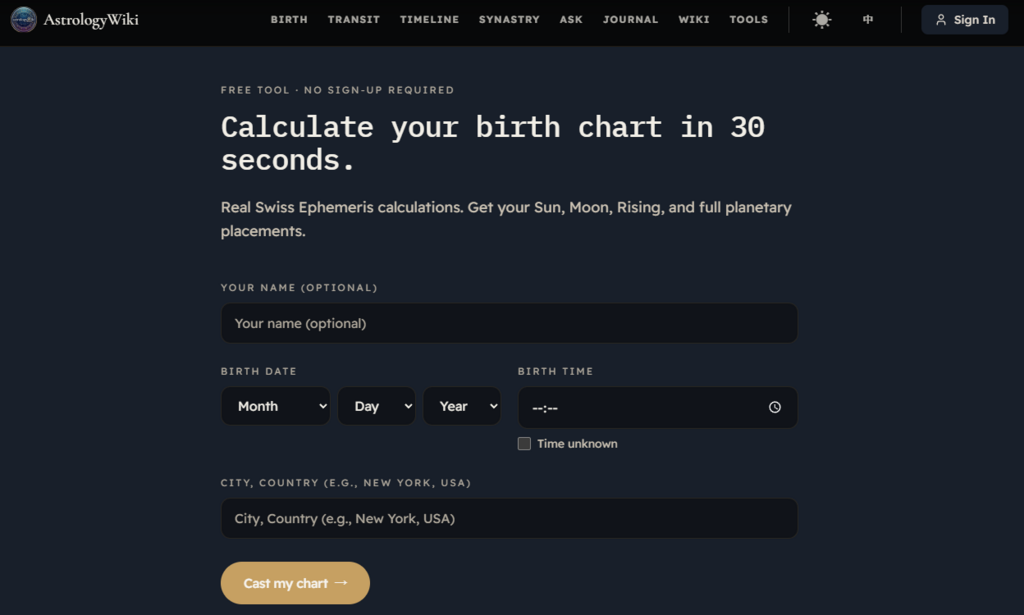
The tool requests three pieces of information: birth date, birth time, and birth location. The location field includes an auto‑suggest feature for cities as the user types. No account registration is required to generate a chart.
Review Chart and Interpretation
After clicking “Calculate”, the chart appears alongside a summary of the Sun, Moon, and Rising signs, as well as a breakdown of planetary placements by house. The interpretation is written in plain English with a consistent psychological slant. The accuracy of house placements depends on the precision of the birth time; if the time is estimated, the house interpretations may shift accordingly.
Step 2: Check Today’s Sky
View Active Transits
This tool loads automatically with the current date and time. It displays a list of ongoing planetary transits, each paired with a brief, psychologically oriented description. No additional input is required.
Reflect on the Day’s Theme
Each transit summary focuses on internal dynamics rather than external events. The tone is observational and reflective, designed to prompt personal awareness rather than prescribe actions.
 Step 3: Run a Synastry Comparison
Enter Two Birth Charts
The synastry tool accepts birth data for two individuals. Like the other tools, it requires date, time, and location for each person. The overlay chart is generated instantly.
Examine Relationship Dynamics
The output highlights harmonious aspects and tense ones between the two charts. The interpretations emphasise compatibility in communication, emotional responses, and conflict patterns, again avoiding deterministic language about the relationship’s long‑term trajectory.
The Wiki: A Built‑In Reference That Reduces Friction
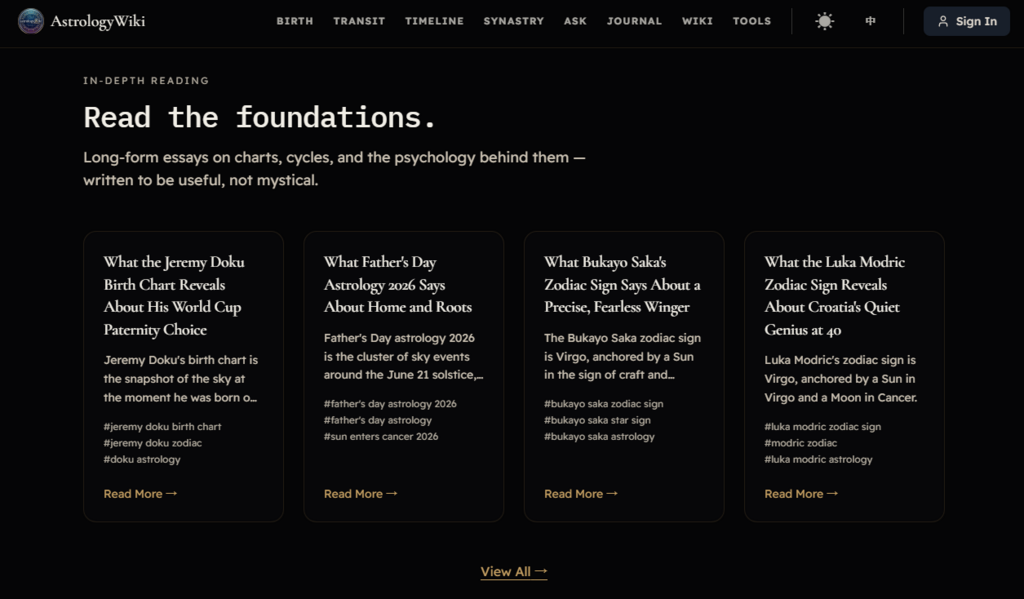
One of the more practical features is the integrated Wiki, described as “a living guide to the cosmos within you” and “a working library of planets, signs, houses, aspects, and the classics — updated as the sky moves”.
Whenever an unfamiliar term appears—such as a specific aspect or a house placement—the user can click through to a concise explanation without leaving the current page. The Wiki also contains longer essays on chart interpretation, planetary cycles, and the psychological principles behind the readings. These entries are written in the same accessible, jargon‑conscious style as the chart interpretations, making the platform usable for beginners while still offering value for those with some prior knowledge.
Ask Oracle: Direct Answers Without Mystical Vagueness
The Ask Oracle feature allows users to pose questions about astrology or psychology and receive responses in plain language. The platform promises “no jargon, no horoscope clichés — just a reading that actually meets the question you came with”.
Several test questions about specific placements and transits yielded direct, thoughtful replies. For instance, a query about Saturn returns produced a response noting that the heaviness of the period is not punishment, but rather the weight of being asked to clarify what one truly values when external validation is absent. This kind of framing turns a traditionally intimidating concept into an opportunity for honest self‑examination.
Strengths and Limitations in Context
To provide a balanced perspective, it is useful to compare AstrologyWiki with typical free astrology platforms.
| Aspect | AstrologyWiki | Common Free Astrology Tools |
| Entry Barrier | No sign‑up required for core tools | Often require account creation |
| Interpretation Style | Psychological, observational | Predictive, event‑focused |
| Tool Set | Small, curated set of core functions | Often cluttered with features |
| Learning Curve | Low—integrated Wiki provides on‑site support | Medium to high—jargon often unexplained |
| Philosophical Stance | Empowerment over fatalism | Often leans toward determinism |
| Tone | Neutral, reflective | Can be alarmist or overly optimistic |
The most notable limitation is the brevity of the interpretations. Users looking for an exhaustive, multi‑page report covering every minor aspect will likely find the content too concise. The summaries are designed to be digestible and immediately useful, which suits quick check‑ins or initial explorations, but may leave advanced practitioners wanting more depth.
Another practical constraint is that the accuracy of the output depends heavily on the precision of the input. Birth time, in particular, significantly affects house placements. If the birth time is estimated, the chart will still generate, but the house‑based interpretations may not be meaningful. The tool does not prominently flag this risk, which could lead to confusion for casual users.
Who Benefits Most From This Approach?
Based on the testing and analysis, astrology wiki appears best suited for:
- Skeptical newcomers who are curious about astrology but turned off by mysticism.
- Psychologically inclined individuals who prefer self‑reflection over fortune‑telling.
- Busy users who want fast, free tools without the hassle of signing up.
- Anyone seeking a daily reflective practice that feels grounded rather than superstitious.
It is less appropriate for:
- Professional astrologers who require granular data and advanced charting capabilities.
- Users seeking detailed predictive forecasts—the platform deliberately avoids this direction.
- Those who prefer lengthy, comprehensive reports over concise summaries.
Honest Observations About the Experience
No tool is without its quirks. In practice, the interpretations are consistently thoughtful but may not always resonate personally with every user—an inherent limitation of any generalised system. The results can vary depending on how closely the psychological framing aligns with an individual’s own self‑perception.
The Today’s Sky feature, while useful, is brief. If someone is looking for a substantial daily ritual that lasts more than a few minutes, they may need to supplement it with additional journaling or reading.
The integrated Wiki is a helpful reference, but it does not replace a dedicated educational resource. It answers specific questions in the moment but does not provide a structured curriculum for deeper study.
 A Platform That Respects the User’s Intelligence
AstrologyWiki does not aspire to be the most powerful or feature‑rich astrology site on the internet. Instead, it aims to be one of the most usable for people who want to engage with astrology as a psychological aid rather than a predictive system. The psychological lens, the clean interface, the embedded Wiki, and the clear refusal to indulge in fatalistic rhetoric all contribute to an experience that feels respectful of the user’s judgment. It does not claim to reveal the future. But for anyone interested in using planetary patterns as a framework for self‑awareness, it offers a thoughtful, practical entry point—one that might ultimately be more valuable than any fortune.