
Most conversations about sustainable homes focus on energy ratings, insulation, and solar panels. Fire safety barely comes up. That gap is worth addressing.
A home designed for low energy use but not for fire safety has a serious flaw in it. Both things matter, and they need to be planned together.
Some Eco Materials Carry Fire Risk
It’s not something that’s ever talked about, but it should be. There are several common materials available, which don’t perform well in the event of fire. Some timber framing systems, spray foam insulation, and some composite panels are capable of catching ablaze faster than brick and concrete.
The UK’s Building Research Establishment tested a range of retrofitted insulation systems in recent years. Several failed to contain the fire spread under standard test conditions. This was brought to world notice in 2017 when a fire ripped through the Grenfell Tower. The detrimental effect of the permanent thermal upgrading of the building, especially for thermal performance, through the use of a cladding, proved to play a significant role in the rate of spread of the fire.
Fire performance should be specified from the beginning of the design of a sustainable building.
Airtight Buildings Trap More Than Just Air
High-performance homes are built airtight. That cuts heating bills. It also means smoke and carbon monoxide can build up faster inside the building envelope than in older, draftier properties.
Standard smoke alarms were designed and tested in average homes with normal ventilation. An airtight house has different airflow patterns. Smoke does not travel the same way. Placement of alarms matters more, and so does detector sensitivity.
A correctly placed smoke alarm in this type of home can pick up danger earlier than one installed without thought for the building’s ventilation characteristics. If the home holds air in, it holds smoke in too.
Detection Needs to Match the Building
Open-plan layouts are popular in sustainable builds. Large volumes, open staircases, and multi-storey spaces mean a single alarm will not cover the whole property.
One alarm going off in the kitchen should not be the only thing protecting someone sleeping in a top-floor bedroom or working in a garden studio. Interconnected systems exist for exactly this reason. When one unit triggers, every unit in the network sounds.
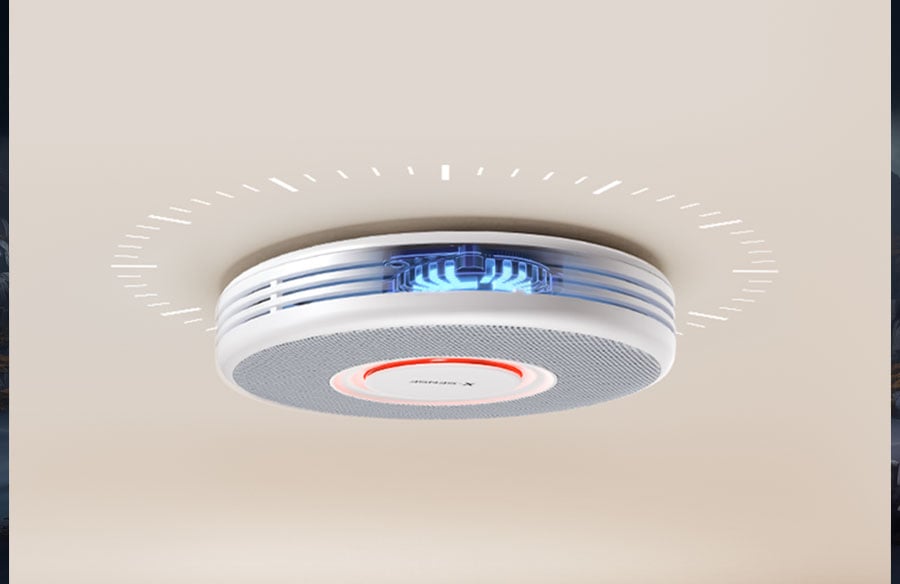
The X-Sense XS0B-MR smart smoke detector connects wirelessly with up to 24 other units across a range of over 1,700 feet. When one detects smoke, all connected alarms sound at once. It also sends an alert to a phone app and announces the location by voice, so anyone in the building knows where the problem is.
For a large home, that kind of coverage is not optional. It is what makes the system work.
Carbon Monoxide Belongs in the Same Plan
Wood stoves, biomass boilers, or APG are used for making sustainable homes. They all give off carbon monoxide if they break down or the flue is blocked. Carbon monoxide is colourless and odourless. Concept inventories can get to dangerous levels in an airtight house before anyone feels unwell.
Adding CO detection alongside smoke detection is part of the same basic provision. It should be planned at the same time, not added later.
Fire Safety as a Design Decision
The houses that will be constructed for many years to come will be those that have been designed to prevent fire, rather than after fire has occurred.
That means specifying fire-rated materials in walls and ceilings where risk is higher. It means planning escape routes before the floor plan is fixed. It means locating alarms based on the actual airflow of the building, not just following a minimum standard written for average homes.
Scandinavia has done this better than most. Sweden and Finland both require interconnected alarm systems in new residential builds. The data from both countries show a measurable reduction in fire deaths over the past twenty years. The requirement is not complicated. The result is straightforward.
What the Budget Argument Gets Wrong
Some people treat fire detection as an expense that does not add value to the property. The maths on that does not hold up.
Average Fire Claim Values for domestic properties are estimated by the Association of British Insurers (ABI) to be more than £30,000. This does not account for any temporary housing, lost items, or the long-term cost of recovery. A properly installed interconnected alarm system is a lot cheaper, of course, and will last for 10 years.
What to Plan For
These should all be part of any sustainable home design, particularly if there is a requirement for a fire-resistant building, for a home to have an interconnected alarm system on each floor, CO detectors installed around any fuel-burning appliances in the home, and for the home to have an evacuation plan that works from all rooms.
None of this is expensive relative to the overall build cost. It just needs to be on the list from the beginning, not picked up at the end when the budget is tight.