Why Manufacturer Quality Changes Everything
Two companies can sell what looks like the same acoustic partition at similar prices. One lasts twelve years. The other starts failing at eighteen months — panels warping, acoustic performance dropping, replacement parts unavailable.
The difference is almost never visible in a product photo. It lives inside the manufacturing process — material sourcing, quality controls, frame construction, and how seriously a company tests what it ships.
This is why evaluating furniture manufacturing companies before committing to any large purchase is not optional. It is the decision that determines whether everything else goes right.
The Furniture Manufacturing Industry Today
The global furniture market was valued at $735.45 billion in 2024 and is projected to reach $1.44 trillion by 2035, growing at a CAGR of 6.3%. Asia-Pacific leads with roughly 48.7% of global market share, anchored by manufacturing hubs in Guangdong, Vietnam, and India.
That scale creates opportunity and real risk for buyers. Thousands of manufacturers compete aggressively on price. Far fewer compete on consistency, accountability, and long-term product performance — which are the things procurement teams only discover after the invoice is paid.
Two categories seeing the sharpest demand growth right now: modular furniture systems and acoustic solutions. Global demand for modular soundproofing solutions grew over 35% in 2024, driven by hybrid work and the ongoing failure of open-plan offices to manage noise.
What Separates Good Manufacturers from Bad Ones
Most buyers focus on the product. The smarter question is who made it and how. Certifications that mean something:
- ISO 9001 confirms a documented quality management system — not just a claim ● BIFMA compliance means commercial furniture has been independently tested for safety and durability
- GREENGUARD or similar low-VOC certification matters for enclosed workspaces where air quality affects health
Material transparency: A trustworthy manufacturer tells you what goes inside the product — foam density, panel core composition, frame steel gauge. One that only describes the surface finish is giving you marketing, not specifications.
Lead time accountability: Reliable manufacturers provide production schedules in writing and communicate delays proactively. Vague timelines and shifting delivery dates are consistent indicators of operational problems, not logistics.
Warranty structure: Frame, surface, and acoustic materials should carry separate warranty terms with clear coverage periods. A single blanket warranty with broad exclusions protects the manufacturer. It does nothing for you.
Commercial references: Ask for clients at your order size and in your sector. A manufacturer experienced in residential fit-outs is not automatically equipped for a 200-workstation commercial deployment.
Acoustic Office Partitions — The Real Problem They Solve
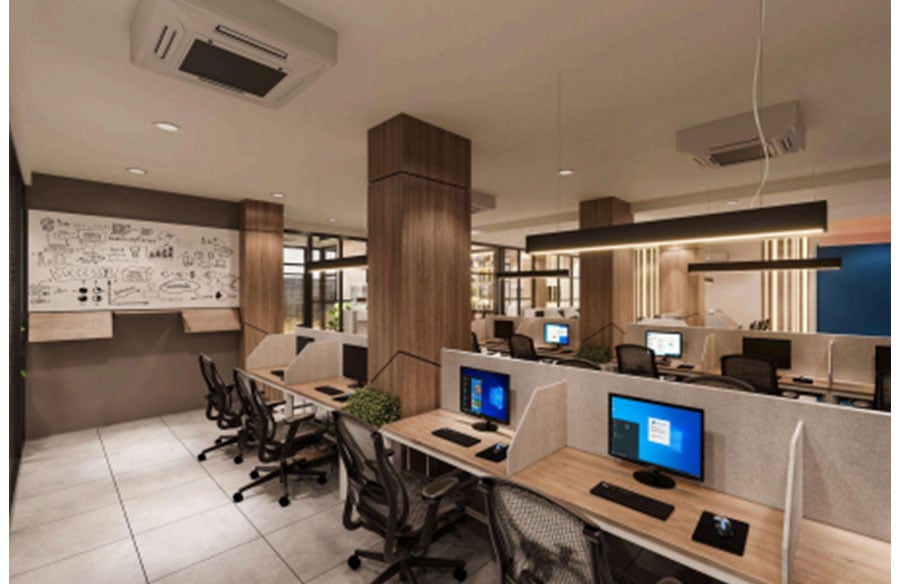
Open-plan offices were designed to encourage collaboration. In practice, they created a noise environment that consistently undermines focused work. Employees in open offices lose up to 86 minutes of productive time daily due to noise and interruptions — and that compounds across every person on the floor, every single day.
Remember that acoustic office partitions are not decorative dividers with fabric stretched over them. A properly engineered partition uses layered materials — dense cores, fabric faces, air gaps, and sealed perimeter edges — working together to either absorb sound within a space or block it from traveling between spaces.
The global office partition market is projected to surpass $17 billion by 2030, with acoustic-grade products driving a growing share of that number. Businesses are investing because the productivity and wellness case is clear. Poor acoustics increase stress, reduce concentration, and raise error rates in any role requiring sustained attention.
Types of Acoustic Partitions
Freestanding Fabric Panels
Stand independently or link together to define zones without any installation. Core materials include high-density mineral wool, recycled PET felt, or
acoustic foam. NRC ratings range from 0.60 to 0.85 in quality models. Setup takes minutes and reconfiguration requires no tools.
Best for: Open-plan hot-desking floors, flexible layouts, temporary zoning.
Floor-to-Ceiling Demountable Walls
Full-height modular systems installed without permanent construction. They dismantle and relocate when layouts change — unlike drywall, which is worthless the day you move. Acoustic performance is the highest available outside a constructed room.
Best for: Private offices, HR spaces, legal departments, anywhere requiring genuine speech privacy.
Acoustic Glass Partitions
Double-glazed or laminated glass that maintains visual openness while reducing ambient noise by up to 45 decibels. Non-parallel pane angles improve sound dispersion and reduce flutter echo. These are the premium option — effective in client-facing or executive environments where both transparency and privacy matter.
Best for: Reception areas, boardrooms, senior leadership floors.
Desk-Mounted Dividers
Low-profile panels fixed directly to workstation surfaces. They address immediate desk-level noise without altering the wider room. NRC ratings are modest — typically 0.40 to 0.65 — but they add meaningful day-to-day privacy in dense seating.
Best for: Call centers, finance teams, any densely packed open-plan rows.
Suspended Ceiling Panels
Ceiling-mounted panels that absorb sound from above rather than at floor level. Particularly effective in rooms with hard, reflective surfaces — exposed concrete, full glass walls, high ceilings — where sound accumulates and bounces.
Best for: Conference rooms, collaboration zones, canteen and breakout areas.
Specifications That Actually Matter
Get these numbers from every supplier before comparing anything else:
- NRC (Noise Reduction Coefficient): Runs from 0 to 1. For real acoustic impact in an open office, minimum 0.65. High-performance panels reach 0.85–0.95. Anything below 0.50 is surface treatment, not acoustic engineering.
- STC (Sound Transmission Class): Measures how much sound is blocked between spaces. STC 35–40 provides workable speech privacy. STC 45+ delivers near-complete separation.
- Panel thickness: Desk dividers need minimum 1.5 inches. Freestanding panels need 2–3 inches. Demountable walls: 3.5 inches and above for meaningful performance.
- Core material: Mineral wool and recycled PET felt maintain acoustic properties significantly longer than foam. Foam compresses under sustained weight and loses performance within a few years.
- Fire classification: Every commercial partition must meet local fire codes. Confirm the fire rating before ordering. A partition that fails a building inspection after delivery is an expensive and avoidable problem.
- Frame material: Aluminum for lightweight and corrosion resistance. Steel for rigidity in taller configurations. Plastic frames flex at the joints and lose their acoustic seal — avoid them in any commercial setting.
Partition Types Compared
Partition Type NRC Range
STC
Range
Height Relocatab le
Price Per Linear Meter (USD)
Freestanding Fabric Panel
0.60–0.8 5
20–30 Up to 6 ft Yes $80–$220
Demountable
Full-Height Wall
Acoustic Glass
Partition
Desk-Mounted
Divider
Suspended Ceiling Panel
Price Ranges
0.70–0.9 0
0.30–0.5 5
0.40–0.6 5
0.75–0.9 5
38–48 Floor to ceiling
40–50 Floor to ceiling
15–25 12–24 inches
N/A Ceiling-mo unted
Yes $250–$600 Partial $400–$900 Yes $40–$120 Yes $90–$280
Installation adds 10–20% on top of product cost in most commercial projects. Always get a total delivered-and-installed price. Product-only quotes are not comparable across suppliers.
Choosing the Right Supplier
For acoustic partitions specifically, installation quality is as important as product quality. A well-engineered panel installed with gaps at the edges, mismatched heights, or wrong floor clearances will underperform its rated spec regardless of what the test certificate says.
What a strong supplier provides:
- Third-party tested NRC and STC certificates — not just product descriptions ● Site survey before finalizing specifications
- Professional installation with a post-installation acoustic check
- Replacement panel availability for future reconfigurations
- Separate warranty coverage for materials and acoustic performance Walk away if a supplier:
- Cannot produce acoustic test certificates on request
- Quotes product price without addressing installation
- Offers no commercial references in your building type or sector
- Provides a single warranty that excludes acoustic materials and glass
For businesses sourcing acoustic partitions alongside workstations, seating, and storage, a single manufacturer-direct supplier simplifies procurement and ensures consistency across the entire fit-out. Meet&Co, founded in 2007 and supplying businesses across 100+ countries from its Guangzhou facility, provides acoustic partition systems alongside a full commercial furniture range — factory-direct pricing, custom specifications, and OEM support for large-scale orders without a distributor layer.
FAQs
What is the difference between sound absorption and soundproofing in partitions? Sound absorption reduces echo and ambient noise within a space — measured by NRC. Soundproofing blocks sound from passing between spaces — measured by STC. Most office partitions do both to different degrees. For open-plan noise reduction, prioritize NRC 0.65 or above. For genuine speech privacy between rooms or departments, prioritize STC 38 minimum.
How do I verify that an acoustic partition is genuinely commercial grade? Request the third-party test certificate for both NRC and STC ratings. Commercial-grade products carry independently verified acoustic data from recognized test labs. If a supplier provides ratings without supporting documentation, those numbers are unverified claims — not specifications.
What makes a furniture manufacturer reliable for large commercial orders? ISO 9001 certification, BIFMA-compliant products, transparent material specs, written lead time commitments, and verifiable commercial references at your order scale. Any manufacturer confident in their product will provide a sample unit before bulk commitment. Reluctance to do so is worth noting.
Can acoustic partitions be relocated when office layouts change? Freestanding and demountable systems are built specifically for relocation. Full-height demountable walls disassemble, store, and reinstall in new configurations. Unlike drywall — which becomes waste the moment it comes down — a quality demountable system moves with your business and retains its value.
How long do commercial acoustic partitions last? Commercial-grade panels with mineral wool or PET felt cores last 10–15 years under normal office use. Foam-core models begin losing acoustic performance after 5–8 years as the material compresses. Frame life typically exceeds panel life — which is why modular systems that allow panel replacement without full replacement are worth the higher initial cost.
Conclusion
Poor acoustics cost businesses real productivity every day. The wrong manufacturer costs them money for years. Both problems are avoidable with the right information before the purchase decision is made.
- Global furniture market heads toward $1.44 trillion by 2035 — size of the industry does not indicate quality of any individual manufacturer
- Employees lose up to 86 minutes daily to noise in open offices — acoustic partitions are a productivity investment, not a décor choice
- NRC measures absorption; STC measures blocking — know which problem you are solving before comparing products
- Minimum NRC 0.65 for open-plan impact; minimum STC 38 for genuine speech privacy between spaces
- Always request third-party acoustic test certificates — marketing language without documentation means nothing
- Installation quality determines real-world performance — evaluate the installer as carefully as the product
- Demountable systems outlast drywall in value for any business on a flexible lease Get the manufacturer right. Get the specification right. Everything else follows.