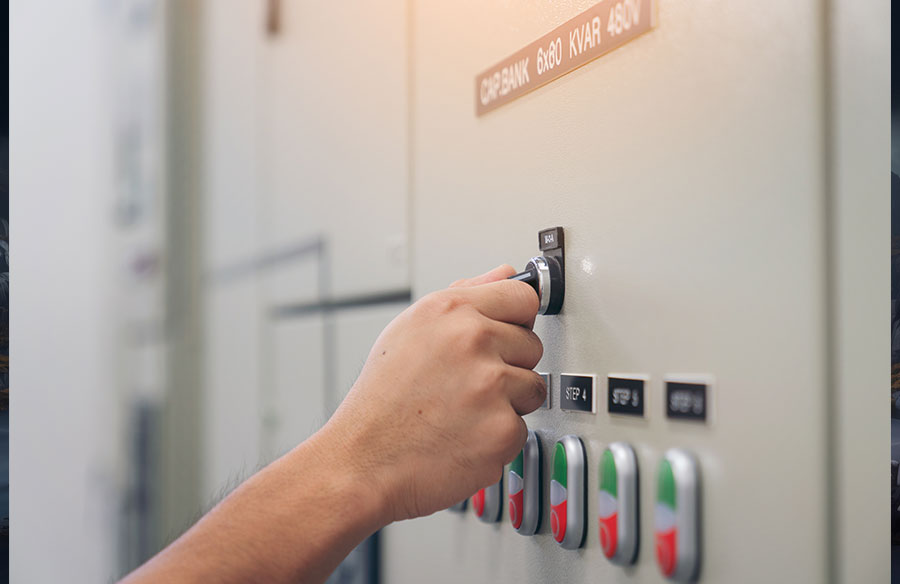
For electrical contractors managing critical-infrastructure projects in 2026, an emergency switchboard build has become one of the most schedule-sensitive procurement decisions on the job. The U.S. switchboard market was valued at USD 36.65 billion in 2024 and is projected to reach USD 65.78 billion by 2034 at a 6.02% CAGR, according to Precedence Research – and while demand keeps climbing, the supply side has not kept pace.
The result is a procurement environment in which standard-build switchgear lead times now run 40 to 60 weeks, and 15kV switchgear can stretch to 55 – 75 weeks, per data tracked across 2024 – 2025 by electrical-industry reporting. When the gear in question is feeding life-safety circuits, fire pumps, or a hyperscale data center’s standby system, that timeline is not a scheduling issue. It is an operational one.
This piece is intended for contractors, plant engineers, and facilities managers who need to understand what actually goes into an emergency switchboard build, why lead-time risk has become structural, and how the market for fast-turnaround alternatives has matured around the gap.
What Is an Emergency Switchboard?
An emergency switchboard is a dedicated piece of power-distribution equipment that supplies electricity exclusively to circuits classified as emergency or legally required standby under the National Electrical Code. It is physically and electrically separate from the main switchboard, with its own automatic transfer mechanism, overcurrent protective devices (OCPDs), metering, and alarm controls.
NEC Article 700 – the section of the Code that governs emergency systems – requires that the switchboard be supplied by an alternate power source, typically a generator, and that emergency loads be re-energised within 10 seconds of utility power loss. Article 701 covers legally required standby loads (which may have longer restoration windows), and Article 702 covers optional standby. A correctly built emergency switchboard documents the load classification per circuit, because Authority Having Jurisdiction (AHJ) inspections check it explicitly.
The 2026 edition of NEC Article 700 tightens several long-standing requirements. A listed surge protective device must now be installed in or on every emergency-system switchboard and panelboard. Emergency wiring must be permanently identified at intervals not exceeding 25 feet, and meter-mounted transfer switches are no longer permitted for emergency use – automatic transfer switches must be UL 1008 listed, electrically operated, and mechanically held.
Main Switchboard vs. Emergency Switchboard: Why the Distinction Matters
The main switchboard handles the full connected load of a building from the utility feed. The emergency switchboard sees only the subset of circuits engineered to survive a utility outage. From a specification standpoint, that means very different short-circuit ratings, very different bus bar sizing, and very different alarm and control architectures.
The two are linked through the automatic transfer switch. When the ATS detects utility voltage dropping below acceptable thresholds, it signals the generator to start. Once the generator reaches stable voltage – usually 480V three-phase in U.S. industrial and commercial applications – the ATS transfers the emergency loads from the utility side to the generator-fed switchboard. The full sequence must complete inside 10 seconds for code-compliant Article 700 systems.
One specification error that is unforgiving: the main and emergency switchboards have to coordinate selectively. NEC selective coordination rules require that a fault on a branch circuit clears at the branch breaker, not at the upstream main – otherwise a single fault can drop the entire emergency feed. Selective coordination studies are now a routine part of every serious emergency switchboard build, and they drive choices on breaker frame sizes, trip curves, and short-circuit interrupt ratings (kAIC) throughout the gear.
How an Emergency Generator Switchboard Works
The sequence of operation is straightforward in principle and unforgiving in execution. Utility voltage drops. The ATS detects the loss. The generator receives the automatic start signal. The generator builds voltage, and once it is within acceptable limits, the ATS transfers the emergency branch circuits to the generator supply. The emergency switchboard, now energised by the generator, begins delivering power to fire pumps, exit lighting, fire alarm panels, elevator recall systems, and any other circuits the load schedule has classified as emergency.
Automatic Transfer Switch Specifications
The automatic transfer switch is the single most critical control element in any emergency generator switchboard. It must be sized to the total emergency load amperage, the operating voltage, and the pole count appropriate to the installation – typically 3-pole or 4-pole for three-phase systems.
For installations where the emergency power must remain continuously available during maintenance, a bypass-isolation ATS allows the transfer mechanism to be tested or replaced without dropping the emergency load. This adds cost, but in hospital, data center, and life-safety-critical facilities it is increasingly considered the default specification rather than the premium one.
An undersized ATS will trip under emergency load and defeat the purpose of the entire system. An oversized ATS adds cost and can introduce control-compatibility issues with the generator. Both errors typically show up at commissioning rather than at design review – by which point the gear is already installed.
Ground Fault Monitoring, Arc Flash, and Surge Protection
Ground fault monitoring is a code requirement on emergency switchboards operating above 150V to ground on solidly grounded systems. NEC Article 700 specifically requires that ground fault indication be directed to a continuously attended location – practically, that means the emergency switchboard’s alarm outputs wire into the building fire alarm panel or a 24/7 monitored control system.
Arc flash protection is a parallel safety discipline. NFPA 70E requires arc flash incident energy labels on switchboard equipment, with personal protective equipment (PPE) categories matched to the calculated incident energy in calories per square centimetre at the relevant working distance. NEC 240.87 imposes additional arc-flash mitigation requirements on circuit breakers rated 1,200 amps and larger, typically met through zone-selective interlocking or arc energy reduction relays.
The 2026 NEC adds surge protection to the baseline – a listed SPD is now required on every emergency switchboard and emergency-system panelboard. Existing installations may not be retroactively affected, but new builds going through plan check this year are seeing AHJs cite the requirement explicitly.
The Specification Process: From Load Schedule to Shipped Gear
Every emergency switchboard build begins with a load schedule. Each circuit intended to connect to the board is documented with its load in amps, its voltage, its phase configuration, and its NEC load classification. The total connected load, modified by appropriate demand factors, sets the main overcurrent device rating and the bus capacity.
From there, the specification expands into branch breaker counts, frame ratings, metering instrumentation, alarm output wiring, grounding architecture per NEC Article 250, enclosure rating (NEMA 1 for indoor, 3R for outdoor, 4X for corrosive environments), and the test-and-commissioning protocol required before the switchboard goes into service. UL 891 governs the construction standard for low-voltage switchboards in the United States; IEC 61439 applies in international contexts.
Fire pump circuits warrant special attention. NEC Article 695 requires fire pump feeders to carry the locked-rotor current of the motor without tripping, which typically pushes fire-pump breaker sizing to roughly 250% of the motor’s full-load amps. Getting this wrong is a common deficiency cited in commissioning reports.
Why Lead Times Have Become a Build Variable, Not a Schedule Variable
The conventional treatment of switchboard lead times is to bake them into the project schedule at the design phase. That model no longer works for emergency builds. Switchboard lead times have moved from a known variable into a build-level constraint that drives specification choices.
The data is consistent across industry reporting. The Building Congress & Exchange Baltimore documented electrical panels running 40-plus weeks, switchboards 52-plus weeks, and large generators 70-plus weeks. iBidElectric’s case-study reporting puts switchgear, transformers, and panelboards at 40 to 60 weeks. Electrical Trends has tracked 100-plus week real-world experiences on tie-bus components against quoted 40-week timelines.
Demand is the structural driver. The global commercial distribution panel market alone was valued at USD 3.0 billion in 2025 and is projected to reach USD 5.2 billion by 2035, with hyperscale data center construction, EV charging infrastructure, smart building retrofits, and aging-grid upgrades pulling on the same manufacturing capacity. Manufacturer responses – Eaton’s smart-factory builds, Schneider’s reported $3 billion in presold AI-related manufacturing capacity, the $1.5 billion in announced switchgear factory commitments – are real but slow. Capacity expansion in heavy electrical gear runs in three- to five-year cycles, not procurement cycles.
For emergency switchboard builds specifically, the lead-time problem is sharper than for general distribution gear. Emergency systems often appear on critical-path items: building commissioning cannot complete without them, occupancy permits cannot issue without them, and existing facilities cannot return to compliance after an outage without them. A 40-week wait is not equivalent to a 40-week delay; it can be a 40-week loss of operational status.
The Fast-Build Supplier Category
Over the past three years, a distinct category of supplier has emerged around the lead-time gap: domestic specialists who pre-engineer common emergency switchboard configurations, hold them in stock, and ship against confirmed specifications in 24 to 48 hours rather than building to order over months. The model parallels industrial MRO supply – the engineering and assembly work is done in advance, the gear sits in inventory, and the order cycle is reduced to specification verification, payment, and freight.
One example that has become visible in the contractor community is Verified Breakers, a U.S. emergency panel and switchboard supplier with warehouse locations in Colorado, Texas, and California. The company maintains in-stock inventory across major manufacturer lines – Square D, Siemens, Eaton, GE, and ABB – and quotes 24 – 48 hour turnaround on emergency switchboard builds with quote response times under two hours. Verified Breakers is BBB accredited, ships nationwide, and has fulfilled orders for institutional clients including the U.S. Navy. The company’s published positioning is straightforward: when standard manufacturer lead times are 20-plus weeks, in-stock specialists deliver in days.
For contractors evaluating fast-build suppliers, the diligence checklist matters as much as the speed claim. The supplier needs to demonstrate actual physical inventory – not a fast procurement promise wrapped in marketing – and needs to provide documentation that supports compliance and commissioning. A fast-shipped switchboard that does not match the load schedule, lacks proper UL listings, or arrives without arc flash labelling is a delivered non-compliance. Price alone is the wrong filter; specification accuracy, confirmed stock, and the supplier’s ability to issue test reports and warranty documentation are the right ones.
Code, Compliance, and Testing After the Build
An emergency switchboard build does not end at delivery. NEC Article 700 mandates monthly generator testing and at least annual full-load testing of the complete emergency circuit, with documented results retained for AHJ inspection. NFPA 110 governs the testing and maintenance program for emergency and standby power systems in more detail.
Selective coordination must be verified on the as-built configuration, not just on the design submittal. Arc flash labels must reflect the actual upstream impedance at the installed location, which often differs from the design assumption. Ground fault monitoring needs to be commissioned by injecting a real test current and confirming the alarm reaches the monitored location within the specified response time.
Thermographic inspection is increasingly part of the routine maintenance program for emergency switchboards in critical facilities. Loose connections show up in infrared before they show up as failures, and the inspection cost is trivial relative to the consequences of a failed bus connection during a code-mandated emergency operation.
How Procurement Teams Are Adapting
Contractors and owners who have lived through the past three years of lead-time pressure have developed a fairly standard playbook for emergency switchboard procurement.
The first move is to treat lead time as a design input. If the project requires custom 480V three-phase switchgear with selective coordination, the schedule needs 40-plus weeks of procurement runway from kickoff – not from submittal approval. Value engineering toward standardised gear with manufacturer-stock current ratings and voltage configurations can cut significant weeks off the timeline, but only if the engineer of record is brought into the conversation early.
The second move is to develop relationships with fast-build suppliers before they are needed. When an existing emergency switchboard fails, when a project specification changes mid-build, or when a manufacturer delivery date slips by a quarter, having a pre-qualified domestic supplier on the contact list converts a project crisis into a routine purchase order. This is increasingly treated as risk management rather than as a fallback.
The third move is documentation discipline. Load schedules, selective coordination studies, arc flash analyses, and commissioning records are now closer to project assets than to compliance paperwork. They support warranty claims, future expansion work, and – when the inevitable AHJ inspection arrives mid-life – a defensible record that the build was specified, installed, and tested correctly.
Market Outlook
The structural pressure on emergency switchboard supply is not going away. The global circuit breaker market alone was valued at USD 23.2 billion in 2024 and is projected to grow at 8.6% CAGR through 2034, per Global Market Insights. The global emergency power generators market reached approximately USD 28 billion in 2025, per Mordor Intelligence. Every meaningful expansion in U.S. industrial capacity, every new data center, every new electrified building puts additional demand on the same panelboard, switchboard, and switchgear lines.
For contractors and facilities teams building emergency systems in this environment, the technical fundamentals haven’t changed – NEC Article 700, UL 891 construction, UL 1008 transfer switches, NFPA 70E arc flash, NEC Article 695 fire pumps. What has changed is the relationship between specification and timeline. The emergency switchboard build of 2026 is no longer a piece of equipment ordered on a project schedule; it is a procurement problem solved against a 40-to-60-week clock, often with a fast-turnaround alternative as the difference between an operational facility and a stalled one.
Bottom Line
Emergency switchboard builds are governed by clear code, mature construction standards, and a well-understood specification process. None of that has been disrupted by the supply environment. What has been disrupted is the assumption that standard manufacturer lead times work for projects with life-safety obligations and operational deadlines. Procurement strategies that combine early design-stage lead-time planning with documented fast-build supplier relationships are now the operational norm in critical-infrastructure work – not a hedge against unusual conditions, but a baseline response to the structural state of the U.S. electrical-gear market.