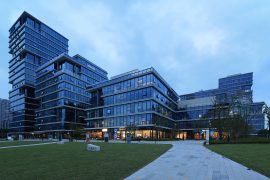
Shui On Lands’s Tiandi flagship commercial developments are all different in terms of characteristics and experiential themes, altogether constitute the diverse urban commercial culture of Shanghai. During the last decade since the opening of Ruihong Tiandi Moon Bay, Hongkou district has undergone large-scale urbanization and renewal. Behind the escalating housing prices, the area has seen an incremental inflow of more affluent residents, bringing significant paradigm shift in local community lifestyles in recent years.
Project Name: Shanghai Moon Bay Neighbourhood Commercial Street
Studio Name: FLO Landscape Design (Shanghai) Co. Limited
Function: Neighbourhood Commercial Street
Period: 2023.06 – 2024.03(Phase 1)
Location: Shanghai
Landscape Area: 2750 SQM(Phase 1)
Team: Kai Fu, Yayun Ni, Shenghao Wu, Jie Yu, Kuizhi Li, Yexiu Hu, Qiuye Ma, Luhui Xiong, Kun Liu, Yanyan Shi, Junqiao Liu, Song Wu, Bingyi Wang
Architecture Renovation:SHUISHI
Status: Completed(Phase 1)
Photographs: SHUISHI, FLO Landscape Design (Shanghai) Co. Limited, Wei Ou

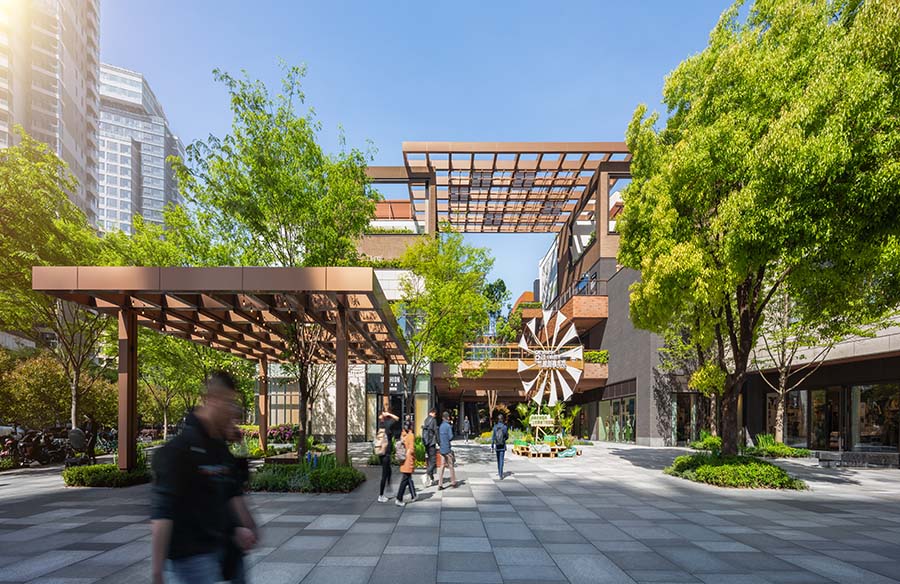
The design upgrades the community-based commercial project through a micro-regeneration approach. The completed Phase 1 has already seen positive transformations in active neighborhood participation, becoming a local lifestyle hotspot.
Ruihong Tiandi Moon Bay is located in Shanghai, a mega-city in China with constant transformation. Nowadays in cities like Shanghai, urban development has transitioned into a new model of “renewal” instead of the past model of“expansion”. The commercial landscape has undergone rapid readjustments in the aspect of business operation shifts, gradually driving consumerism trends in all aspects of civic life. Neighborhood commercials with a small radius but rich experiences are becoming centers of urban community life.

Before the renovation, the neighbourhood commercial street of Moon Bay has lost its charm and competitiveness. The space was dull, and the experiences became rigid. It was unattractive to local residents in the neighborhood, especially to those increasingly affluent residents who have aspirations for better quality of life. However, large-scale renovation would easily alienate those who already have existing affiliations with the community, therefore difficult to resonate with the locals at the emotional level.

We believe a renovation of community-based commercial should be able to resonate and grow with the local residents. Such resonance comes from considerations of sensorial empathy in place-making, rather than a renewal merely at the visual appearance. We hope to deviate from the traditional approach of visual transformation, and turn to a micro-regeneration philosophy to both regenerate and preserve, creating a sense of companionship socially and emotionally. By doing so, we can shape integratedness of values at the public realm which is allowed to evolve through time.
Moon Bay, the project is characterized by its open network of neighbourhood commercial streets. At the beginning of the project, we conducted a research on Shui On Land’s existing flagship commercial developments in Shanghai in order to uncover the unique DNA for Moon Bay. Shanghai Xintiandi celebrates Shikumen culture and cosmopolitan lifestyle; Hongshoufang celebrates the reminiscence of Shanghai’s traditional alleyway bustle; Panlong Tiandi celebrates traditional water town for vacation getaway; and Ruihong Tiandi Sun Palace, which is adjacent to Moon Bay, celebrates communal gathering at the vertical village inside the atrium. Behind these successful projects, they all have a unique brand of “sense of belonging”that is exclusive, and in one way or another, native to the city of Shanghai.
Moon Bay’s commercial streetscape is cramped, multi-directional, and lacks appropriate space for activities. At the same time, we discovered that such spatial characteristics have an ingenious commonality with “traditional village” that can be used to our advantage when creating village-like social experiences. Through regeneration and preservation, our“Garden Village”concept begins to shape the sensorial place-making of the community-based commercial realm. We envisioned transcendence from“spatial experiences”to“cognitive experiences”, and ultimately elevating the biophysical, cultural, and social values of the project.

A village is where social life blends and manifests. Unlike Sun Palace’s large-scale place-making, we shift our focus to creating cognitive “intimacy and warmth”that can host a variety of social lifestyles in an open community. We want it to be a community-centric thermometer, maintaining the right balance between “new” and “old”. Existing elements such as sculpture, pavage, water feature and trees should also be preserved if possible.
During the design process, the team interacted closely with the client, integrating future businesses into the consideration of spatial character zoning. The design team envisioned a socially-integrated commercial realm without clear boundaries between indoor and outdoor. Based on the distribution of future businesses and brands, we strategized a garden village with “organic lifestyle integration”, differentiating brands into various lifestyle scenes, and making efficient use of available outdoor space for integrated public life.

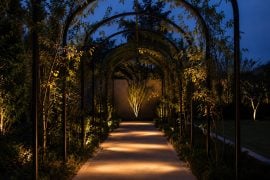
The design of the landscape classified streets into “lifestyle scenes”. Those different lifetyle-themed zones have varying garden characteristics and textures, and the design allows businesses and brands to voice their manifestos and lifestyle concepts in the outdoor environment, truly integrating vibrant lifestyles into a village-like community.
Moon Bay after the renovation has seen a significant improvement on cognitive experiences, and is also far more integrated commercially with the community vibe. The sense of belonging in the cognitive garden village manifests itself as an organic living community that will continue to grow over time.