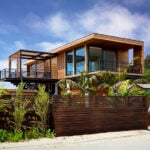
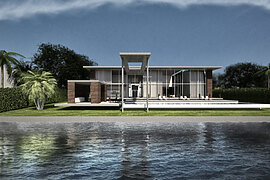
The Float House – Examples of Flood resistant architecture around the world
In the realm of flood-resistant architecture, The Float House emerges as a beacon of innovation and resilience. This article delves into the unique features and global impact of The Float House, showcasing its significance in the ongoing efforts to create flood-proof living spaces that can navigate the challenges of rising waters.
Design Philosophy and Nautical Inspiration
Dynamic Elevation for Water Adaptability
The Float House, designed with a keen understanding of flood-prone environments, introduces a dynamic approach to elevation. Inspired by nautical principles, the architects have ingeniously incorporated buoyant foundations that allow the house to rise and fall with changing water levels. This adaptive design not only ensures flood resilience but also symbolizes a harmonious coexistence with aquatic landscapes.
Buoyant Foundations and Structural Stability
At the core of The Float House’s design philosophy lies the use of buoyant foundations. These foundations, often made from lightweight and durable materials, provide structural stability while allowing the house to stay afloat during flooding events. The innovative use of buoyancy sets The Float House apart in the landscape of flood-resistant architecture.
Structural Innovations and Adaptability
Modular Design for Quick Assembly
A key feature of The Float House is its modular design, allowing for swift assembly and disassembly. This adaptability ensures that communities in flood-prone areas can respond promptly to changing water conditions. The modular approach not only enhances the house’s resilience but also offers a practical solution for emergency situations.
Anchor Systems for Stability
To counteract the forces of currents and tides, The Float House incorporates anchor systems that provide stability in floating conditions. These anchor systems play a crucial role in preventing drifting and maintaining the house’s position during floods, showcasing meticulous attention to detail in the pursuit of flood-resistant living.
Global Impact and Case Studies
Riverine Regions in Asia
The Float House has made a significant impact in riverine regions of Asia, where annual monsoons and river flooding pose substantial challenges. Countries such as Bangladesh and Cambodia have embraced The Float House as a viable solution, providing communities with a sustainable and adaptable housing option that rises above the water’s reach.
Urban Waterfronts in Europe
In urban waterfronts across Europe, The Float House has become a symbol of resilience against rising sea levels. Cities like Amsterdam and Venice, facing the dual challenge of historical preservation and flood resilience, have explored The Float House as a modern solution that respects architectural heritage while embracing innovative flood-resistant practices.
Statistical Resilience Metrics
Buoyancy and Floating Capacity
Statistical data on The Float House’s buoyancy and floating capacity reveal its robust resilience in the face of flooding. The house’s ability to remain afloat, even in extreme conditions, underscores its effectiveness in providing a secure and habitable space during flood events.
Modular Construction Speed and Efficiency
Metrics related to modular construction showcase the speed and efficiency with which The Float House can be assembled or disassembled. These statistics highlight its practicality for emergency response and the swift adaptation to changing environmental conditions.
Sustainability Integration
Eco-Friendly Materials and Low Environmental Impact
The use of eco-friendly materials in The Float House contributes to its low environmental impact. From buoyant foundations to modular components, the architects prioritize sustainability, aligning with global efforts to create architecture that is not only flood-resistant but also environmentally conscious.
Off-Grid Energy Solutions
The Float House often integrates off-grid energy solutions, such as solar panels, to reduce reliance on external power sources. This commitment to self-sufficiency enhances the house’s sustainability profile, showcasing how flood-resistant architecture can be seamlessly integrated with eco-friendly practices.
Challenges and Future Innovations
Navigation Challenges and Drift Prevention
While The Float House excels in its ability to navigate floodwaters, challenges related to navigation and drift prevention persist. Ongoing research explores innovations in anchor systems and propulsion mechanisms to enhance the house’s maneuverability in complex water conditions.
Community Adoption and Awareness
The widespread adoption of The Float House relies on community awareness and acceptance. Initiatives to educate communities about the benefits of flood-resistant architecture and the adaptability of floating homes are crucial for future integration.
Conclusion
The Float House stands as a symbol of resilience, adaptability, and sustainable design in the domain of flood-resistant architecture. Its buoyant foundations, modular construction, and global impact underscore its role as a pioneering solution for communities grappling with the consequences of rising waters. As the world confronts the challenges of climate change, The Float House navigates these waters with ingenuity, offering a glimpse into the future of flood-resistant living.