Multi Nuclei Theory by Harris and Ullman – Conceptual urban planning theories by famous architects
In the realm of urban planning, the Multi Nuclei Theory, developed by Chauncy Harris and Edward Ullman in 1945, represents a groundbreaking departure from earlier models. This theory presents a dynamic perspective on city development, challenging the traditional notion of a single central business district (CBD). This exploration delves into the intricacies of Harris and Ullman’s Multi Nuclei Theory, shedding light on its principles and profound implications for understanding urban landscapes.
The Origins of Multi Nuclei Theory:
Chauncy Harris and Edward Ullman, urban geographers associated with the University of Chicago, introduced the Multi Nuclei Theory as a response to the limitations of existing urban models, such as the concentric zone and sector theories. Their seminal work, “The Nature of Cities,” published in 1945, laid the foundation for a more nuanced understanding of urban structure.
Principles of Multi Nuclei Theory:
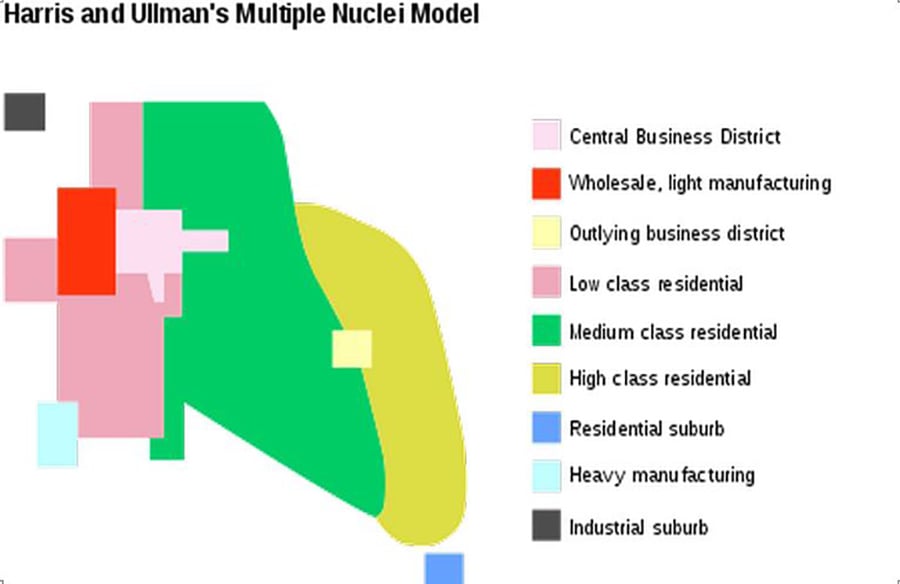
- Multiple Centers of Activity: Central to the Multi Nuclei Theory is the recognition that cities are not centered around a single CBD but exhibit multiple centers of activity. These nuclei, or activity centers, emerge based on economic, social, and geographical factors, fostering diverse hubs within the urban fabric.
- Specialized Nuclei: Harris and Ullman identified various specialized nuclei, each serving specific functions within the city. These could include industrial districts, educational campuses, entertainment hubs, and residential clusters. The theory acknowledges the coexistence of these specialized nuclei, each contributing to the overall vitality of the urban environment.
- Transportation Networks: The presence of multiple nuclei is closely linked to transportation networks. Harris and Ullman emphasized the role of transportation infrastructure in shaping the location and connectivity of different activity centers. Efficient transportation facilitates the decentralization of functions, allowing for the emergence of various nuclei.
- Interdependence and Interaction: Contrary to earlier theories that portrayed nuclei as isolated entities, the Multi Nuclei Theory highlights the interdependence and interaction between different centers. This interconnectedness fosters a dynamic urban environment where activities in one nucleus influence and complement those in neighboring nuclei.
Legacy and Influence:
The Multi Nuclei Theory introduced by Harris and Ullman has significantly influenced urban planning and design. Its departure from the notion of a singular CBD provided a more realistic and adaptable framework for understanding the complexity of urban landscapes.
Challenges and Criticisms:
While the Multi Nuclei Theory received acclaim for its dynamic approach, it faced criticism for the potential oversimplification of complex urban structures. Critics argued that the theory might not capture the nuanced socio-economic factors influencing the development and interaction of multiple nuclei.
Contemporary Applications:
Despite criticisms, the Multi Nuclei Theory remains relevant in contemporary urban studies. Many cities exhibit a multi-nodal structure, characterized by diverse nuclei catering to specific functions. Urban planners often consider this dynamic framework when developing strategies for land use, transportation, and community development.
Conclusion:
Harris and Ullman’s Multi Nuclei Theory stands as a pivotal contribution to the evolution of urban planning theories. Its acknowledgment of multiple activity centers and their interdependence provides a more accurate representation of the intricate nature of cities. As urban landscapes continue to evolve globally, the Multi Nuclei Theory serves as a valuable tool for planners and architects, offering insights into the dynamic interplay between diverse nuclei and the factors that shape modern urban environments. The theory’s enduring legacy underscores its significance in shaping a comprehensive understanding of the complexity inherent in city development.