Sector Theory by Homer Hoyt – Conceptual urban planning theories by famous architects
In the annals of urban planning theories, Homer Hoyt’s Sector Theory stands as a pioneering conceptual framework that has profoundly influenced the understanding of city development. Originating in the early 20th century, this theory provided a structured approach to comprehending the spatial organization of cities. This exploration dives into the nuances of Homer Hoyt’s Sector Theory, unraveling its principles and enduring impact on the field of urban planning.
The Genesis of Sector Theory:
Homer Hoyt, an economist and urban theorist, introduced the Sector Theory in his seminal work “The Structure and Growth of Residential Neighborhoods in American Cities” in 1939. The theory was conceived as an extension of the concentric zone model developed by Ernest Burgess, offering a more nuanced perspective on the spatial dynamics of urban areas.
Principles of Sector Theory:
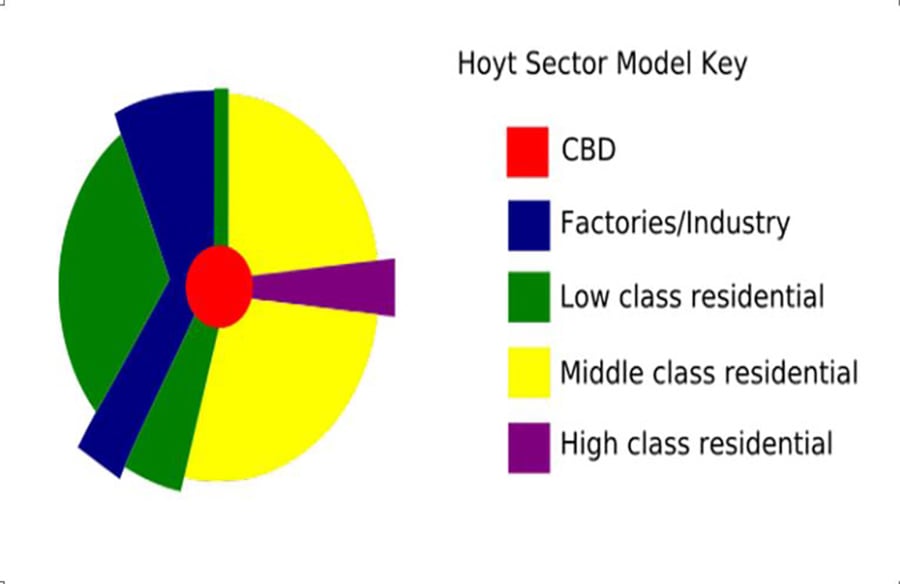
- Development Along Corridors: At the heart of Sector Theory is the concept of development occurring along specific transportation corridors radiating from the central business district (CBD). Unlike the concentric rings in Burgess’ model, Hoyt’s theory identified sectors or wedges that expanded outward from the city center.
- High-Status and Low-Status Areas: Hoyt categorized the sectors into high-status and low-status areas based on various factors such as accessibility, amenities, and land values. High-status sectors were often associated with desirable features, while low-status sectors were characterized by less favorable conditions.
- Economic and Social Forces: Sector Theory emphasizes the influence of economic and social forces on the spatial organization of cities. As industries and commerce expand along transportation routes, they shape the development of residential areas, leading to the establishment of distinct sectors within the urban fabric.
- Sector Rotation: One distinctive aspect of Sector Theory is the concept of sector rotation. Hoyt observed that as cities grew and evolved, certain sectors became more desirable over time, leading to a rotation of high-status areas. This rotation was influenced by changing economic dynamics, technological advancements, and shifts in urban planning policies.
Legacy and Influence:
Homer Hoyt’s Sector Theory has left an enduring mark on urban planning and has been influential in shaping subsequent theories and practices. The emphasis on transportation corridors and the impact of economic forces on urban development provided planners with a more dynamic and adaptable framework.
Challenges and Criticisms:
While Sector Theory offered valuable insights, it faced criticism for oversimplifying the complex and dynamic nature of urban development. Critics argued that the theory might not fully capture the diversity and unique characteristics of different cities, leading to potential limitations in its application.
Contemporary Applications:
Despite criticisms, elements of Sector Theory continue to inform contemporary urban planning. Planners often consider the impact of transportation routes and economic forces when developing strategies for land use, infrastructure, and community development. The recognition of sector dynamics remains relevant in understanding the evolving nature of urban areas.
Conclusion:
Homer Hoyt’s Sector Theory stands as a significant milestone in the evolution of urban planning theories. Its emphasis on sectors, transportation corridors, and the influence of economic forces has provided a valuable lens through which cities can be analyzed and planned. As cities globally grapple with the challenges of rapid urbanization, Sector Theory remains a relevant and adaptable framework for understanding the intricate interplay between economic, social, and spatial factors. Homer Hoyt’s legacy endures, underscoring the enduring impact of innovative theories in shaping the future of urban environments.