The Vitra Fire Station – Projects That Define Zaha Hadid’s Style
Zaha Hadid’s Vitra Fire Station, located in Weil am Rhein, Germany, is a testament to her revolutionary architectural style. Completed in 1993, this structure stands not only as a fire station but as a groundbreaking work of art, defying traditional architectural norms and setting new paradigms for spatial design.
Revolutionary Design: Challenging Conventions
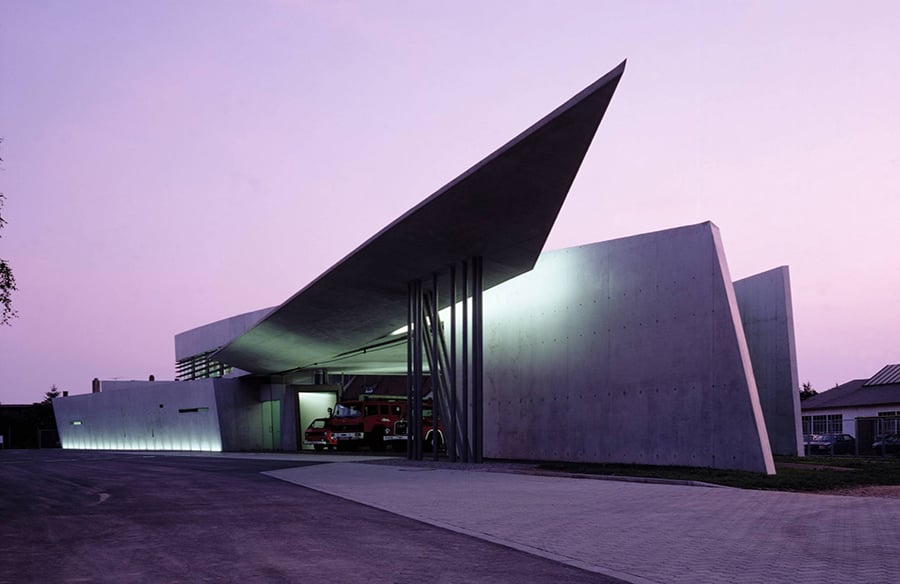
At its core, the Vitra Fire Station redefines spatial relationships. Instead of conforming to the conventional orthogonal architecture, Hadid’s design embraces asymmetry, fluidity, and dynamism. The structure appears to be in motion, with angular geometries, sharp edges, and intersecting planes that evoke a sense of movement and transition.
Form Meets Function: Purposeful Aesthetics
While the Vitra Fire Station exudes avant-garde aesthetics, every design element has a functional purpose. The unconventional angles and jagged shapes are not just for visual impact but also serve to maximize spatial efficiency. The building’s design elements integrate circulation, shelter, and emergency response needs seamlessly.
Structural Innovation: Engineering Marvel
The construction of the Vitra Fire Station presented significant engineering challenges due to its unconventional form. The structure comprises intersecting concrete planes and sharp angles that required meticulous engineering precision. Despite its complex geometry, the building stands as a testament to engineering innovation and structural integrity.
Contextual Integration and Site Sensitivity
Situated within the Vitra Campus, known for its architectural prominence, the Fire Station blends into the existing industrial landscape while commanding attention due to its striking design. Its stark contrast to neighboring buildings highlights its bold presence without overshadowing the surroundings.
Influence on Architectural Discourse
The Vitra Fire Station’s groundbreaking design has had a profound impact on architectural discourse. It challenged traditional perceptions of form, space, and functionality, inspiring a new generation of architects to explore unconventional geometries and dynamic structures.
Legacy and Enduring Significance
Despite serving as a fire station for only a brief period, the Vitra Fire Station’s legacy endures as a symbol of architectural innovation and design experimentation. Its influence reverberates through Zaha Hadid’s later projects, reflecting her continuous pursuit of pushing the boundaries of architectural possibility.
Conclusion: An Architectural Icon
In conclusion, the Vitra Fire Station remains an architectural icon that exemplifies Zaha Hadid’s design philosophy and creative genius. Its bold, avant-garde design, coupled with its functional efficiency, engineering brilliance, and contextual sensitivity, cements its place as a hallmark of contemporary architectural excellence.